

ENT (Ear, Nose and Throat) · Jaipur Hospital
Ear and Hearing Care in Jaipur
Ear pain, blocked hearing, or ringing? Get a clear assessment and a simple plan at Jaipur Hospital.
- Serving Jaipur since 1991 (35 years)
- NABH accredited
- 24×7 emergency & ICU
- Cashless: RGHS, MAA Yojana, CGHS + 22 insurers
- Consultation length
- 15 to 30 minutes
- Anaesthesia
- Not needed
- Recovery
- Immediate
- Price
- ₹800 to ₹3,500typical range in India; ask us for an estimate
Ear problems disrupt daily life
Your ear hurts, feels blocked, or you cannot hear clearly
Ear pain, a feeling of fullness, ringing sounds, or muffled hearing can make conversations hard and work tiring. You may worry about using cotton buds or drops that make things worse.
-
Pain and pressure
Sharp or dull earache with a blocked sensation that does not clear.
-
Hearing feels muffled
You ask people to repeat themselves or turn the TV volume up.
-
Ringing or dizziness
Buzzing sounds or unsteadiness that interrupts sleep and focus.
-
Worry about home remedies
Cotton buds push wax deeper; drops can worsen a blockage.
-
Recurring infections
Repeated ear discharge or infections that keep coming back.
By age three, 80% of children have had at least one middle ear infection.
Why Jaipur Hospital
You want the discomfort to stop without a long hospital stay or a confusing list of tests.
Your care plan
Your first steps with us
- 1 Call or visit OPD for an ENT consultation
- 2 Get examined with microscope and hearing tests
- 3 Review results and agree on a treatment plan
- 4 Receive treatment and scheduled follow-up visits
How we assess and treat your ear
Your surgeon examines the ear canal and eardrum, checks hearing thresholds, and removes wax or treats infection as needed.
-
Otoscopy and Microscopy
Magnified view of the ear canal and eardrum to spot wax, infection, or perforation.
-
Pure Tone Audiometry
You wear headphones in a soundproof booth and respond to tones at different pitches and volumes.
-
Tympanometry
A soft probe changes air pressure slightly to check eardrum movement and middle ear function.
-
Ear Microsuction
Wax and debris are gently suctioned out under a microscope for a clear view.
Why patients trust us
- 1991 Serving Jaipur for 35 years
- NABH Accredited hospital
- 2 ENT (Ear, Nose and Throat) consultants
- 24×7 Emergency, ICU and ambulance
- 25 Cashless schemes and insurers
What studies show about ear care outcomes
-
About 5% of adults
Studies estimate that roughly 5 in 100 adults experience impacted earwax needing removal.
-
80% of children by age three
Research shows most children have at least one middle ear infection before their third birthday.
-
50% with hearing impairment
WHO data indicates half of chronic suppurative otitis media cases involve some degree of hearing loss.
If it is left untreated
Untreated ear infections can spread to nearby bone, causing balance problems or facial nerve weakness. Chronic discharge may lead to progressive hearing loss. Impacted wax left in place can worsen blockage and trigger infection.
Life after your ear is treated
Most people return to normal conversation, sleep, and work once the blockage or infection is cleared.
-
Clearer conversations
You follow dialogue in noisy rooms and on the phone without straining.
-
Restful nights
Ringing or discomfort that disturbed sleep usually settles after treatment.
-
Confidence at work
You attend meetings and take calls without asking colleagues to repeat themselves.
-
Simple ear care
You know how to keep ears clean safely without cotton buds or risky drops.
Frequently asked questions
Questions patients ask about ear and hearing care
Which problems are assessed under ear and hearing care?
In short
At Jaipur Hospital our ear and hearing care service covers a wide range of conditions. These include ear infections, wax build-up, hearing loss, tinnitus, dizziness, and balance problems. The team also evaluates middle ear fluid, eardrum perforations, and cholesteatoma.
In detail
The service uses otoscopy and microscopy for a magnified view of the ear canal and eardrum. Pure tone audiometry measures the faintest tones you can hear at different frequencies and intensities in a soundproof booth. Tympanometry checks middle ear pressure and eardrum mobility.
Ear microsuction removes wax and debris safely under a microscope. Evidence shows these tests detect conductive or sensorineural hearing loss, middle ear effusion, and structural problems such as cholesteatoma.
In studies, 80 percent of children experience acute otitis media by age three, and chronic suppurative otitis media remains a leading cause of preventable hearing loss worldwide.
- In studies, 80 percent of children experience acute otitis media by age three, and chronic suppurative otitis media remains a leading cause of preventable hearing loss worldwide.
Your next step at Jaipur Hospital
If you notice hearing difficulty, ear pain, discharge, ringing, or a blocked sensation, book a consultation at Jaipur Hospital. The outpatient visit takes 15 to 30 minutes and costs typically between Rs 800 and Rs 3,500. No anaesthesia is needed and recovery is immediate. Your surgeon will advise the right tests and treatment after examining you.
How will the doctor decide which tests I need for ear and hearing care?
In short
The doctor at Jaipur Hospital decides which tests you need based on your symptoms, history, and the initial ear examination. If you have hearing difficulty, pure tone audiometry is standard. If middle ear pressure problems are suspected, tympanometry is added. Speech audiometry checks word understanding. Bone conduction testing helps locate the type of hearing loss.
In detail
The audiometry test procedure typically includes an initial consultation about symptoms, history of ear infections, noise exposure, or medication use. The doctor uses otoscopy and microscopy to examine the ear canal and eardrum. If wax blocks the view, microsuction may be done first.
Pure tone audiometry measures the faintest tones you hear at various frequencies (Hz) and intensities (dB). Speech audiometry assesses how well you hear and repeat spoken words.
Bone conduction testing uses a small device behind the ear to test if hearing loss is due to inner ear or middle ear problems. Tympanometry checks the mobility of your eardrum and middle ear system. The audiologist plots responses on an audiogram for evaluation. The test serves multiple purposes including detecting hearing loss, evaluating ear health, and assessing occupational risks.
A common belief
Patients often ask for every test available.
What actually happens
But tests are selected for your specific problem. For example, tympanometry is added only if middle ear pressure issues are suspected. Wax must be cleared first for accurate results. You may be asked to remove hearing aids during testing.
Your next step at Jaipur Hospital
The doctor will select tests after examining you. The consultation takes 15 to 30 minutes. The typical price range is ₹800 to ₹3,500. Bring your medical records and medicine list. Avoid loud noise before the visit.
Inform the doctor about any ear pain or recent infections. Your surgeon will explain the test plan and next steps.
How soon should I expect improvement after the chosen ear or hearing treatment?
In short
Improvement timing depends on the specific condition and treatment given. At Jaipur Hospital, our team will give you a clear idea of what to expect for your situation. For earwax removal by microsuction, relief is usually immediate. For infections, symptoms often start to improve within a few days of starting medication. Hearing after ventilation tube insertion typically improves right away.
In detail
Evidence indicates that earwax issues usually resolve on their own as ears naturally move wax outward, but when microsuction is performed, the blockage is cleared at once and hearing returns immediately.
For acute otitis media, pain and fever often settle within 48 to 72 hours of appropriate antibiotics, though fluid behind the eardrum may take weeks to clear completely. With ventilation tubes, hearing improvement is usually noticed as soon as the fluid drains.
For sensorineural hearing loss managed with hearing aids, benefit begins once the device is fitted and programmed, though the brain needs time to adjust to amplified sounds.
Chronic conditions like cholesteatoma require surgery, and hearing recovery depends on the extent of disease and the reconstruction performed. Your surgeon will explain the expected timeline for your specific treatment plan.
A common belief
People often expect instant results for everything.
What actually happens
But fluid behind the eardrum can linger for weeks after an infection clears. Sensorineural hearing loss does not reverse with medicine; hearing aids need an adaptation period. Cholesteatoma surgery is a bigger procedure, and hearing recovery varies. Do not stop treatment early just because you feel better.
Your next step at Jaipur Hospital
After any treatment, follow the instructions given by your doctor or audiologist. Take the full course of any prescribed medicines. Keep ears dry if advised. Attend all follow-up appointments so progress can be checked. If symptoms do not improve within the expected time or if they worsen, contact the hospital promptly.
What type and degree of hearing loss do I have?
In short
The type and degree of hearing loss can only be determined through a comprehensive hearing evaluation. At Jaipur Hospital, the audiologist performs pure tone audiometry, speech audiometry, tympanometry, and bone conduction testing to classify hearing loss as conductive, sensorineural, or mixed, and to grade its severity from mild to profound.
In detail
Pure tone audiometry measures the faintest tones you can hear at various frequencies in hertz and intensities in decibels. Speech audiometry assesses how well you hear and repeat spoken words.
Bone conduction testing uses a vibrating device behind the ear to distinguish inner ear from middle ear causes. Tympanometry checks eardrum mobility and middle ear pressure. The test is conducted in a soundproof room and takes 20 to 30 minutes.
Results are plotted on an audiogram. Sensorineural loss reflects sensory hair cell damage. Conductive loss is due to impaired ossicle movement. Mixed loss has both components. Cochlear synaptopathy can cause speech-in-noise difficulty, tinnitus, and hyperacusis even with normal thresholds.
A common belief
Guessing from symptoms or phone apps is unreliable.
What actually happens
Many people think they have nerve loss when it is just wax or fluid. Only bone conduction testing can separate middle ear from inner ear causes. An audiogram is the standard proof.
Your next step at Jaipur Hospital
Bring any previous ear records and a list of current medicines to the appointment. Avoid loud noise exposure before the test. Impacted wax may need clearance first. Inform the specialist about ear pain, pressure, or recent infections. The audiologist will explain your audiogram and discuss options.
How can I decide whether to seek advice about audiometry and hearing assessment?
In short
You should seek advice about audiometry if you notice difficulty hearing speech, often ask people to repeat themselves, hear ringing or buzzing, feel fullness or pressure in the ears, struggle with phone conversations, or have balance issues. At Jaipur Hospital, our audiologists use pure tone audiometry, speech audiometry, and tympanometry in a soundproof room to measure your hearing thresholds and middle ear function.
In detail
Guidelines suggest adults with no symptoms get tested every 10 years until age 50, then every 3 years. More frequent tests are advised if you are exposed to loud noise or have hearing concerns.
The test evaluates how well you hear tones and spoken words, and checks eardrum mobility. It takes 20 to 30 minutes as an outpatient procedure. You should avoid loud noise before the test, and impacted wax may need clearing first. Bring a list of medicines and any past ear records.
A common belief
People often wait years before testing, hoping hearing will improve on its own.
What actually happens
Home remedies or over-the-counter devices cannot replace a proper audiogram. Early testing catches loss sooner and keeps more options open.
Your next step at Jaipur Hospital
If you recognise any of these signs, or if you are over 60 or work in a noisy environment, schedule a hearing assessment.
The audiologist will explain the results on an audiogram and discuss next steps, which may include hearing aids, further tests, or medical treatment.
Could the ear problem affect hearing, balance, breathing, speech, or swallowing?
In short
Ear problems primarily affect hearing and balance because the inner ear houses both the cochlea and vestibular system. Middle ear conditions can cause conductive hearing loss, fullness, and occasional dizziness. While ear disease does not directly impair breathing or swallowing, severe infections may spread to nearby structures, and chronic otitis media in children can delay speech development due to hearing loss. At Jaipur Hospital, our ENT team evaluates all related functions during consultation.
In detail
Cochlear synaptopathy contributes to speech-in-noise difficulties, tinnitus, and hyperacusis. Cholesteatoma eroding the semicircular canals triggers vertigo. Large cholesteatomas can invade the facial nerve canal, causing facial weakness that may affect speech articulation.
In children, persistent otitis media with effusion during critical language years can lead to speech delay. The Eustachian tube links the middle ear to the nasopharynx, so nasal obstruction or adenoid hypertrophy can worsen ear ventilation, but breathing and swallowing are managed by separate pathways.
A common belief
Parents sometimes attribute speech delay to behavioural issues, missing an underlying hearing loss from glue ear.
What actually happens
Adults may ignore dizziness, not realising it signals inner ear or cholesteatoma progression. A full ENT check connects the dots.
Your next step at Jaipur Hospital
If you notice hearing loss, dizziness, facial asymmetry, or speech concerns in a child with recurrent ear infections, book an ENT assessment promptly. The surgeon will perform otoscopy, microscopy, audiometry, and tympanometry to define the impact. Early intervention protects development and prevents complications.
Which symptoms should prompt me to see a specialist?
In short
You should see a specialist at Jaipur Hospital if you have difficulty hearing speech, especially in noisy places, or frequently ask others to repeat themselves. Other signs include ringing or buzzing in the ears (tinnitus), a feeling of fullness or pressure in the ears, trouble following phone conversations, or balance issues. Ear pain, discharge, or sudden hearing loss also need evaluation.
In detail
Doctors recommend an audiometry test when a patient shows signs of potential hearing issues.
You might be advised to take the test if you experience difficulty hearing speech in noisy environments, frequently ask others to repeat themselves, experience tinnitus, feel fullness or pressure in the ears, have trouble following conversations over the phone, or experience balance issues.
Impacted earwax may cause ear aching, ringing, odour, dizziness, or coughing. Routine screening is recommended for people over age 60 or with high-risk occupations.
A common belief
People often ignore gradual hearing loss or think ringing is normal.
What actually happens
But these can signal treatable conditions. Evidence shows adults with no symptoms should get tested every 10 years until age 50, then every 3 years. If you are exposed to loud noise, more frequent tests are advised.
Your next step at Jaipur Hospital
If you notice any of these symptoms, book a consultation at Jaipur Hospital. The appointment lasts 15 to 30 minutes as an outpatient. No anaesthesia is required. The typical cost range is ₹800 to ₹3,500.
Bring your medical documents and a list of every drug you are taking. Your surgeon will examine you and decide which tests are needed.
How will the results change my care plan for ear and hearing care?
In short
The test results at Jaipur Hospital guide your care plan by showing the type and degree of hearing loss, middle ear function, and speech understanding. If results are abnormal, the audiologist may recommend further tests, hearing aids, or medical treatment depending on the cause and severity. Normal results may mean routine monitoring. The surgeon explains the findings and next steps.
In detail
Pure tone audiometry measures the faintest tones you can hear at various frequencies and intensities. Speech audiometry assesses how well you hear and repeat spoken words. Bone conduction testing identifies if hearing loss is due to inner ear or middle ear problems.
Tympanometry checks eardrum mobility and middle ear pressure. The audiologist plots responses on an audiogram. If results are abnormal, your audiologist may recommend further tests, hearing aids, or medical treatment depending on the cause and severity of the hearing loss detected.
The test also helps check how well hearing aids or cochlear implants are working for ongoing treatment. Evidence shows the role of hearing aids to alleviate symptoms of hearing loss in the management of OME needs further study.
Currently, no viable nonsurgical therapies are available for some conditions. Management of otitis media with effusion largely consists of watchful waiting. Ventilation tubes are primarily for children with chronic effusions and hearing loss.
A common belief
Some people expect a quick fix like drops for all hearing loss.
What actually happens
But treatment depends on the cause. For glue ear, watchful waiting is often the first step. Hearing aids help many, but their role in some conditions needs more study. No viable nonsurgical therapies exist for certain problems.
Your next step at Jaipur Hospital
After the tests, your surgeon will discuss the results and outline a care plan. This may include observation, medication, hearing aids, or referral for further evaluation. The consultation and tests usually take 20 to 30 minutes as an outpatient. The typical price range is ₹800 to ₹3,500. Follow-up appointments will be scheduled as needed.
What should I do if ear or hearing symptoms persist or worsen after treatment?
In short
If symptoms persist or worsen after treatment, contact Jaipur Hospital promptly for re-evaluation. Do not attempt to self-treat with cotton swabs, ear candling, or unverified home remedies. These can push wax deeper, cause infection, or damage the eardrum. Persistent symptoms may indicate a different diagnosis or complication needing further investigation.
In detail
Evidence shows that using cotton swabs disrupts protective ear canal hairs and can traumatise the fragile skin, leading to infection or bleeding. Ear candling does not work and may cause burns or worsen blockages.
Putting drops in an ear with a wax plug may soften the plug but not remove it, making things worse. Essential oils may worsen ear infections. If home remedies do not work and earwax blockage persists, medical evaluation is needed.
For cholesteatoma, recurring foul-smelling discharge and progressive hearing loss are warning signs of growth or complications. Bone erosion can lead to vertigo, facial paralysis, or intracranial spread. Paediatric cholesteatoma is more aggressive and proliferative.
A common belief
Many patients try to clean deeper with buds or try candling.
What actually happens
Both are unsafe. Buds scratch the canal and invite infection. Candling can burn you and does not remove wax. Persistent foul discharge or worsening hearing needs a microscope exam, not home experiments.
Your next step at Jaipur Hospital
Return to the OPD for a repeat examination, which may include otoscopy, microscopy, tympanometry, or repeat audiometry. The consultation takes 15 to 30 minutes. Bring any previous reports and a list of current medicines. The team will adjust treatment or discuss further options.
Which hearing tests are appropriate for my age or my child's age?
In short
The choice of hearing tests depends on age, cooperation level, and the suspected problem. At Jaipur Hospital, our audiologists select tests suited to each patient. For newborns and infants, objective tests like otoacoustic emissions and auditory brainstem response are used. For children who can respond to sounds, play audiometry or visual reinforcement audiometry is done. Adults and older children undergo pure tone audiometry, speech audiometry, and tympanometry.
In detail
Evidence shows that pure tone audiometry measures the faintest tones at various frequencies and intensities. Speech audiometry assesses word recognition. Bone conduction testing distinguishes inner ear from middle ear loss. Tympanometry checks eardrum mobility and middle ear pressure.
The audiometry test procedure includes an initial consultation about symptoms, history of ear infections, noise exposure, or medication use. For children, testing is adapted to developmental stage. Adults with no symptoms should get tested every 10 years until age 50, then every 3 years.
If exposed to loud noise or having hearing issues, more frequent tests are advised. Routine screening is recommended for people over age 60 or with high-risk occupations. The audiologist will decide the appropriate battery after talking with you.
A common belief
One test does not fit all.
What actually happens
A toddler cannot press a button for pure tones, so we use visual reinforcement or play audiometry. Adults need speech testing to understand real-world hearing. Screening every 10 years until 50, then every 3 years, is advised for asymptomatic adults. High-risk jobs or noise exposure need more frequent checks. The audiologist picks the right tools.
Your next step at Jaipur Hospital
If you are unsure which test your child needs, bring them for an initial consultation. The audiologist will observe their response to sound and choose the right method. For adults, a standard pure tone audiogram with speech testing and tympanometry is typical.
FAQ library
Questions and answers about ear and hearing care
When you contact us
Get your ear checked this week
Contact Jaipur Hospital for an OPD consultation with an ENT surgeon, in-house tests if needed, and a clear cost estimate before you decide.
- A consultation with an ENT surgeon in the OPD
- Your scans and reports reviewed, with tests done in-house if you need them (laboratory, X-ray and imaging)
- Your options explained in plain words, including whether you need surgery at all
- A cost estimate before you decide
- Help with cashless treatment under RGHS, MAA Yojana, CGHS and empanelled insurers and TPAs
- Follow-up visits after your treatment
Overview
Ear and Hearing Care: what to know
What ear and hearing care covers
- Outer ear
- Ear canal and eardrum; wax build-up and infections happen here
- Middle ear
- Tiny bones carry vibrations; fluid, infection, or cholesteatoma can affect it
- Inner ear
- Hair cells turn vibrations into nerve signals for the brain
- Hearing loss types
- Conductive, sensorineural, or mixed depending on which part is affected
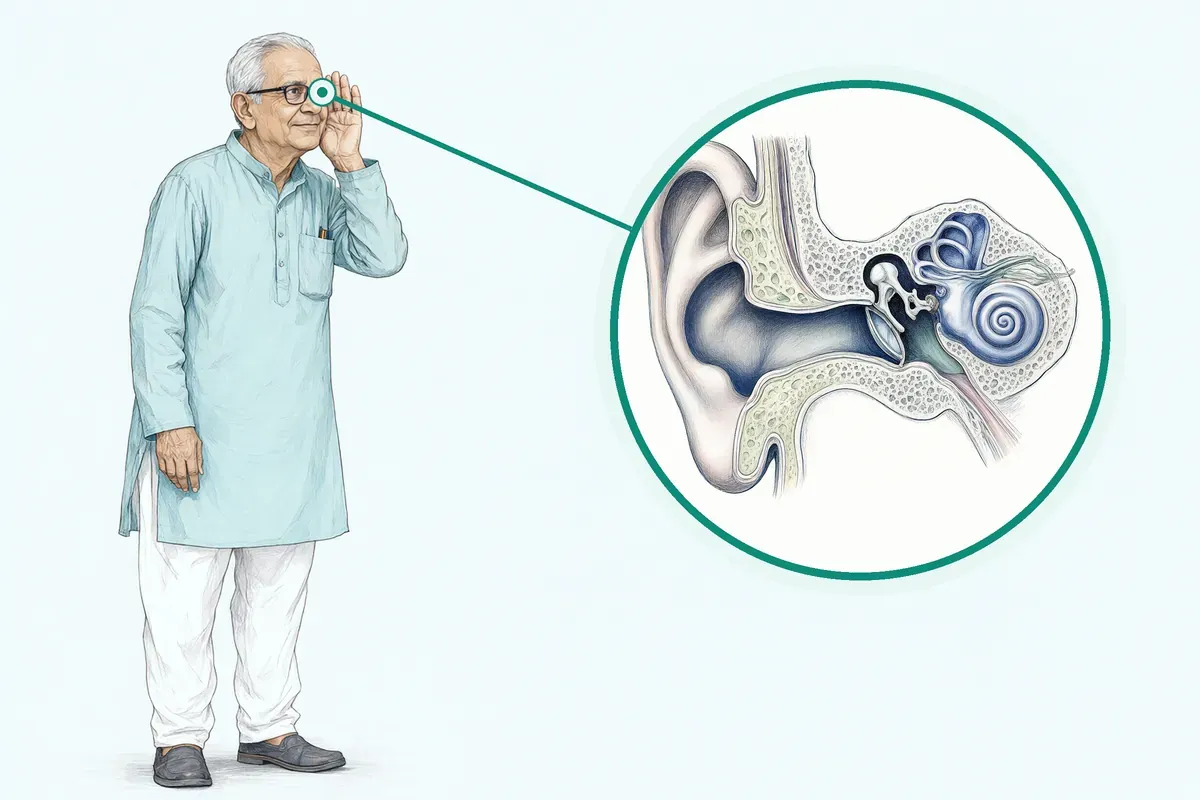
Ear and hearing care at Jaipur Hospital includes a full check of the ear canal and eardrum, hearing tests, and treatment for common problems such as wax build-up and infections. The ear has three parts: the outer ear, the middle ear, and the inner ear. Sound travels through the outer ear canal to the eardrum, which vibrates.
These vibrations pass through tiny bones in the middle ear to the inner ear, where hair cells turn them into signals for the brain. When any part of this pathway is blocked, inflamed, or damaged, hearing can change.
Otitis media is a group of conditions that affect the middle ear. Acute otitis media (AOM) is a sudden infection with pain and a bulging eardrum. Otitis media with effusion (OME), sometimes called glue ear, is fluid behind the eardrum without signs of acute infection.
Chronic suppurative otitis media (CSOM) is long-standing infection with discharge through a hole in the eardrum. These conditions are a frequent reason for medical visits and antibiotic prescriptions.
Cholesteatoma is a non-cancerous skin cyst that grows in the middle ear and the bone behind it. It is not a tumour. It forms from skin cells that collect and shed keratin. Over time the cyst can enlarge and damage the tiny hearing bones, the balance canals, or the facial nerve.
Most cholesteatomas are acquired after birth, often starting from a retraction pocket in the eardrum caused by long-term negative pressure in the middle ear.
Earwax (cerumen) is a normal, healthy substance. It moisturises the canal, repels water, and traps dust and dead skin. The motion of talking and chewing usually moves wax out of the canal on its own. Problems start when wax becomes hard, dry, or pushed deep into the canal, forming a blockage.
This can happen if you naturally make more wax, if the wax does not migrate out quickly, or if earbuds, earplugs, or hearing aids stop the natural flow.
Hearing loss can be conductive (sound cannot reach the inner ear), sensorineural (inner ear or nerve damage), or mixed.
Common causes include:
- Loud noise exposure
- Certain medicines that harm the ear
- Ageing
Some people develop cochlear synaptopathy, where the connections between inner hair cells and nerve fibres are lost. This can make it hard to understand speech in noisy places and may contribute to tinnitus or sensitivity to loud sounds.
Symptoms and warning signs that need urgent care the same day
Common symptoms that bring people to the ear clinic include:
- Ear pain
- A feeling of fullness or pressure in the ear
- Hearing that seems muffled or reduced
- Ringing or buzzing sounds (tinnitus)
- Discharge from the ear
- Dizziness or balance problems
- Itching or irritation in the canal
Impacted earwax can cause earache, a sensation of blockage, tinnitus, dizziness, coughing, and sometimes an odour. A middle ear infection (AOM) typically presents with sudden ear pain and a bulging eardrum. OME often shows up as hearing loss without pain. CSOM usually causes persistent, sometimes foul-smelling discharge and hearing loss.
Cholesteatoma may stay quiet for years. When symptoms appear they often include recurring, scanty, foul-smelling discharge and progressive hearing loss. The hearing loss can be conductive (from stiff or damaged ossicles) or sensorineural (if the inner ear is affected). Tinnitus may also occur.
Seek care on the same day if you have sudden severe ear pain with high fever, sudden complete hearing loss in one ear, weakness or drooping of the face on one side, severe dizziness with vomiting, or discharge that looks like pus or blood after a head injury.
These can signal serious complications such as spread of infection to the bone around the brain, the balance canals, or the facial nerve.
Causes and who is at higher risk
- 37% Children with AOM after viral URI
- 24% Children with OME after viral URI
- 100–200 times higher Cleft palate cholesteatoma risk
Middle ear infections usually start with a viral cold or upper respiratory infection. The virus inflames the lining of the nose and the Eustachian tube, changes mucus properties, and reduces the normal clearance of fluid. This allows bacteria to colonise and travel up the tube into the middle ear.
Many viruses can trigger this, including RSV, rhinovirus, adenovirus, coronavirus, influenza, and others. In young children, about 37% develop AOM and 24% develop OME after a viral upper respiratory infection.
Cholesteatoma develops through several pathways. The most common is a retraction pocket in the eardrum caused by long-standing negative pressure in the middle ear (invagination theory). Other pathways include skin migration through a perforation (immigration theory), metaplasia of the middle ear lining, and basal cell hyperplasia. Many specialists believe the real process is a mix of these. Inflammation and the growth of new blood vessels drive the cyst's expansion and bone erosion.
Risk factors for middle ear infection in children include:
- Young age
- Male sex
- Family history
- Exposure to tobacco smoke
- Attending day care
- Having older siblings
- Using a pacifier
Breastfeeding protects against infection. In low-resource settings, malnutrition, contaminated water, overcrowding, and poor access to care increase the risk of chronic disease and complications. For cholesteatoma, a family history and certain genetic conditions (such as cleft palate) raise the risk significantly. Children with a cleft palate have a 100–200 times higher likelihood of developing cholesteatoma.
Hearing loss from noise, ototoxic drugs, and ageing is common in adults. Cardiovascular risk factors such as smoking and high alcohol intake, low folate levels, and certain inherited blood-clotting gene variants have been linked to sudden sensorineural hearing loss in studies.
Earwax blockage is more likely if you naturally produce more wax, if the wax is dry or slow-moving, or if you use earbuds, earplugs, or hearing aids regularly. Using cotton swabs pushes wax deeper and can injure the canal skin or rupture the eardrum.
How ear and hearing problems are diagnosed: examination and tests
- History and ear examination Otoscope or microscope used
- Pure tone audiometry Press button when you hear a tone
- Speech audiometry Repeat spoken words at different volumes
- Bone conduction testing Vibrator behind ear sends sound to inner ear
- Tympanometry Measures eardrum movement with pressure change
The first step is a detailed history: your symptoms, past ear infections, noise exposure, medicines, and any ear surgery. The doctor then examines the ear canal and eardrum with an otoscope or a microscope. Magnified view (microscopy) lets the surgeon see fine details such as retraction pockets, perforations, cholesteatoma pearls, or wax texture.
Hearing is tested with pure tone audiometry. You sit in a soundproof booth wearing headphones. Tones of different pitch (frequency in Hz) and loudness (intensity in dB) are played. You press a button or raise your hand each time you hear a sound. The softest level you hear at each pitch is plotted on an audiogram.
Speech audiometry checks how well you understand spoken words at different volumes. Bone conduction testing uses a small vibrator behind the ear to send sound directly to the inner ear, bypassing the eardrum and middle ear. This helps tell whether hearing loss is conductive or sensorineural.
Tympanometry measures how the eardrum moves when air pressure in the canal changes slightly. It shows whether there is fluid behind the eardrum, a perforation, or a problem with the middle ear pressure. The test takes a minute and feels like a small pressure change, similar to an aeroplane descent.
The audiometry appointment usually takes 20 to 30 minutes. You can eat and drink normally beforehand. Avoid loud noise exposure for a few hours before the test. If you have impacted wax, it may need to be cleared first so the results are accurate. Bring a list of your medicines and any previous ear records.
If results are abnormal, the audiologist may suggest further tests, hearing aids, or medical treatment depending on the cause and severity.
Treatment options without surgery and when surgery is advised
Do
- Use over-the-counter drops to soften wax
Avoid
- Do not use ear candles
Earwax that causes symptoms is removed under a microscope using a fine suction device (microsuction) or specialised instruments such as a wax spoon or forceps. This is the most common ear procedure in primary care. The magnified view makes it safe and precise.
Over-the-counter drops with hydrogen peroxide or mineral oil can soften wax before removal, but drops alone often do not clear a solid plug. Irrigation with a bulb syringe and warm water or saline can flush out loose wax after softening, but the water must be at body temperature to avoid dizziness.
Do not use cotton swabs, ear candles, or essential oils in the ear canal. Swabs push wax deeper and risk injury. Candling does not work and can burn. Oils may worsen infections.
For acute otitis media, many cases settle with pain relief and observation. Antibiotics are prescribed when guidelines recommend them. Not every ear infection needs antibiotics. Otitis media with effusion is often managed with watchful waiting for three months, as the fluid frequently clears on its own.
If fluid persists with hearing loss, especially in a child with developmental or learning concerns, ventilation tubes (grommets) may be offered. Adenoidectomy is sometimes done at the same time for recurrent infections.
Cholesteatoma does not respond to medicines. There are currently no effective non-surgical therapies. Surgery (mastoidectomy and tympanoplasty) aims to remove the cyst, stop bone erosion, and reconstruct the eardrum and hearing bones if possible. The timing and type of surgery depend on the size, location, and whether complications such as facial nerve involvement or balance canal erosion are present.
Hearing aids are the main non-surgical option for long-term hearing loss. They amplify sound to make speech clearer. The role of hearing aids in OME management needs further study. Your surgeon and audiologist will discuss whether a hearing aid, a bone-anchored device, or a cochlear implant suits your type and degree of hearing loss.
Routine hearing checks are advised every 10 years until age 50, then every 3 years. If you work in loud noise or already have hearing concerns, more frequent tests are recommended.
Your first visit and tests for ear and hearing care
Your first visit at Jaipur Hospital usually takes 15 to 30 minutes. Your doctor will ask about your symptoms, such as difficulty hearing speech, ringing in the ears, a feeling of fullness, or balance issues. They will also ask about any history of ear infections, noise exposure, or medicines you are taking. Bring any previous medical documents and a list of every drug you are taking.
The doctor will examine your ear canal and eardrum using a microscope for a magnified view. This is called otoscopy and microscopy. If needed, hearing tests are done in a soundproof booth. Pure tone audiometry measures the faintest tones you can hear at different pitches and loudness levels. Speech audiometry checks how well you hear and repeat spoken words.
Bone conduction testing uses a small device behind the ear to find out if the hearing loss comes from the middle ear or the inner ear. Tympanometry checks the movement of your eardrum and middle ear pressure.
You can eat and drink normally before the tests; there are no dietary restrictions. Avoid loud noise before the appointment. If you have a lot of earwax, it may need to be cleared before testing. If you wear hearing aids, you may be asked to remove them while their effectiveness is checked.
How ear and hearing care treatment works
Treatment depends on what the examination and tests show. For earwax blockage, the doctor may use microsuction under a microscope to remove wax and debris safely. This is done as an outpatient procedure and usually takes a few minutes.
If you have an ear infection, your doctor may prescribe antibiotic drops or tablets. Not all infections need antibiotics; some are managed with warm or cold compresses and a change in sleep position.
If hearing loss is found, your doctor will discuss the options. These may include hearing aids or other devices. The audiometry test helps check how well hearing aids or cochlear implants are working if you already use them.
For fluid behind the eardrum (otitis media with effusion), the usual approach is watchful waiting for a period. If fluid stays and causes hearing loss or developmental concerns in children, a referral for ventilation tubes may be discussed.
For chronic or recurring infections, or conditions such as cholesteatoma, your doctor may refer you to a surgeon for an operation. The decision for surgery is made after a detailed discussion of the findings.
You will be told how to keep your ears dry and clean at home. A damp washcloth can wipe the outer ear. Cotton swabs should not be put inside the ear canal as they push wax deeper and risk injury. Ear candling does not work and can cause burns.
Risks and possible complications of ear and hearing care
- Examination and hearing tests
- Non-invasive and carry no significant risk
- Microsuction for wax removal
- Generally safe; brief dizziness possible from cold water or air stimulating the balance nerve
- Cotton swabs in the ear canal
- Can damage skin, cause bleeding, infection, push wax deeper, or rupture the eardrum
The examination and hearing tests are non-invasive and carry no significant risk. Microsuction for wax removal is generally safe. Some people feel brief dizziness during or after the procedure because cold water or air can stimulate the balance nerve.
Using cotton swabs inside the ear canal can damage the delicate skin, cause bleeding, or lead to infection. It can also push wax deeper and risk a hole in the eardrum.
Putting drops in an ear with a wax plug may soften the wax but not remove it, which can make the blockage feel worse.
Untreated ear infections can spread. In studies, complications include damage to the bone over the balance canals, which can cause vertigo, and injury to the facial nerve, which can cause weakness of the face. Chronic infection can also lead to cholesteatoma, a skin cyst that grows and can destroy bone.
Cholesteatoma can cause recurring foul-smelling discharge, progressive hearing loss, and in advanced cases, dizziness or facial weakness. In studies, it is linked to bone erosion and serious infections if not treated.
Recovery and aftercare for ear and hearing care
After a consultation or hearing test, you can go back to your normal activities straight away. There is no recovery time needed.
After microsuction for wax removal, you may feel a little sensitivity in the ear canal for a short time. Your doctor may advise keeping the ear dry for a day or two. If you were given antibiotic drops for an infection, use them for the full course as prescribed.
If you have a hearing aid, you will have follow-up appointments to adjust the settings and check how well it is working. The audiometry test is used to monitor this over time.
Call the hospital or return to the OPD if you have:
- Increasing ear pain
- Discharge that smells bad or does not stop
- Sudden hearing loss
- Dizziness that does not settle
- Weakness of the face
These need urgent review.
Results of ear and hearing care treatment
- Every 10 years until age 50 Adults with no symptoms
- Every 3 years after age 50 Adults with no symptoms
In studies, microsuction clears wax effectively in most people and hearing returns to the level it was before the blockage.
For acute ear infections, symptoms often improve within a few days with or without antibiotics. In children, by age three, most have had at least one ear infection, and many have several.
Fluid behind the eardrum (OME) often clears on its own. In studies, watchful waiting is the first step. If ventilation tubes are placed for persistent fluid with hearing loss, hearing usually improves while the tubes are in place.
Hearing aids help many people with hearing loss communicate better. In studies, the benefit varies depending on the type and cause of hearing loss.
Cholesteatoma usually needs surgery to remove the cyst and repair damage. In studies, the condition can come back in some patients, so long-term follow-up is needed.
Regular hearing checks are advised. Adults with no symptoms should be tested every 10 years until age 50, then every 3 years. If you are exposed to loud noise or have hearing issues, more frequent tests are recommended.
Cost and insurance for ear and hearing care in Jaipur
- ₹800 to ₹3,500 Typical price range
- RGHS, MAA Yojana, CGHS, private insurers and TPAs Schemes accepted
The typical price range for ear and hearing care at Jaipur Hospital is ₹800 to ₹3,500. The final cost depends on which tests are needed, whether microsuction is done, and if any medicines are prescribed. Ask us for an estimate before you come.
Jaipur Hospital is a NABH-accredited multispeciality hospital.
We accept patients under:
- RGHS
- MAA Yojana
- CGHS
- A panel of private insurers and TPAs
If you are covered under one of these schemes, bring your card and any approval letter. The hospital has an in-house pharmacy and diagnostic laboratory for your convenience.