

ENT (Ear, Nose and Throat) · Jaipur Hospital
Vertigo and Balance Disorders in Jaipur
Room spins when you move? We find the cause and give you a clear plan.
- Serving Jaipur since 1991 (35 years)
- NABH accredited
- 24×7 emergency & ICU
- Cashless: RGHS, MAA Yojana, CGHS + 22 insurers
- Session length
- 30 to 45 minutes
- Anaesthesia
- Not needed
- Recovery
- Immediate to few hours
- Price
- ₹1,500 to ₹5,000typical range in India; ask us for an estimate
Spinning world, unsteady steps
The room spins when you turn in bed or look up
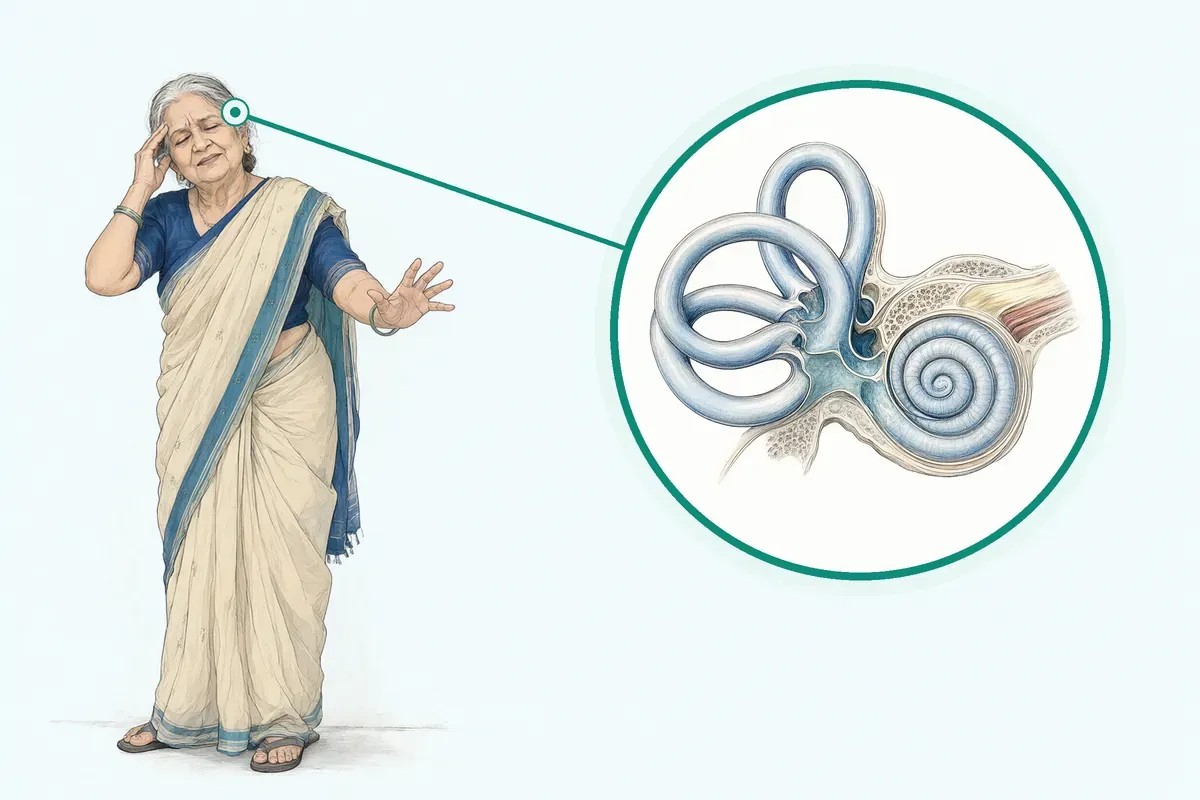
You lie down and the ceiling whirls. You bend to tie a shoelace and the floor tilts. Nausea follows. You avoid driving, skip work, and worry about falling. The cause may be tiny crystals in your inner ear, a migraine variant, or fluid pressure changes — each needs a different approach.
-
Positional vertigo (BPPV)
Brief, intense spinning triggered by rolling over, looking up, or sitting up; usually lasts under a minute.
-
Vestibular migraine
Episodes of vertigo lasting minutes to hours, often with light or sound sensitivity, sometimes without headache.
-
Meniere's disease
Recurring vertigo attacks with fluctuating hearing loss, tinnitus, and a feeling of fullness in the ear.
-
Fear of falling
Unsteadiness between attacks makes you hold walls, skip stairs, and limit going out alone.
-
Delayed answers
Average diagnosis delay for vestibular migraine is over eight years after migraine onset.
Vestibular migraine is the most common cause of episodic vertigo in adults and children.
Why Jaipur Hospital
You worry that the next dizzy spell will hit while you are driving, cooking, or caring for a child.
Your care plan
Your first steps with us
- 1 Call or visit OPD for an ENT consultation
- 2 Complete Dix-Hallpike, VNG, or hearing tests as advised
- 3 Receive a canalith repositioning manoeuvre or start vestibular rehab
- 4 Follow up for recurrence check and lifestyle triggers review
How the assessment and treatment are done
Your surgeon takes a detailed history, checks eye movements with positional tests, and may order VNG or audiometry. Based on the diagnosis, a repositioning manoeuvre or a tailored exercise plan is given in the same visit.
-
Dix-Hallpike and Roll Tests
Provocative tests that identify which ear and which canal is involved in BPPV.
-
Epley or Semont Manoeuvre
Guided head-and-body movements to relocate displaced crystals in the posterior canal.
-
Videonystagmography (VNG)
Objective recording of eye movements to assess vestibular function and rule out central causes.
-
Vestibular Rehabilitation Therapy
Customised gaze-stability and balance exercises to retrain the brain after vestibular injury.
Why patients trust us
- 1991 Serving Jaipur for 35 years
- NABH Accredited hospital
- 2 ENT (Ear, Nose and Throat) consultants
- 24×7 Emergency, ICU and ambulance
- 25 Cashless schemes and insurers
What studies show about these treatments
-
About 8 in 10 people
Report symptom relief after a canalith repositioning procedure for BPPV.
-
Recurrence near 20% at one year
BPPV returned in roughly 19% of patients within 12 months after successful manoeuvre.
-
Nausea in 17 to 32%
Patients experienced nausea during the repositioning manoeuvre; no serious adverse effects were reported.
If it is left untreated
Untreated BPPV raises fall risk, especially in older adults. Vestibular migraine can become more frequent and disabling without preventive care. Meniere's disease may lead to long-term hearing loss over time.
Life after treatment
Most people return to normal movement within hours to days, with a plan to manage triggers and recurrences.
-
Steady mornings
Most people get out of bed without the room spinning after successful repositioning.
-
Fewer surprise attacks
Vestibular migraine patients usually see fewer episodes with trigger control and prophylaxis.
-
Confidence on stairs
Balance exercises help most people walk unafraid of sudden unsteadiness.
-
Clear plan for recurrence
You learn the home manoeuvre and know when to return for a repeat session.


Frequently asked questions
Questions patients ask about vertigo and balance disorders
Which problems are assessed under vertigo and balance disorders?
In short
At Jaipur Hospital, our vertigo and balance service assesses benign paroxysmal positional vertigo, vestibular migraine, and Meniere's disease. The team also evaluates vestibular neuritis, labyrinthitis, and other causes of dizziness or unsteadiness. Each condition is diagnosed using specific clinical tests and, when needed, objective recordings of eye movements.
In detail
Benign paroxysmal positional vertigo is the most common type of vertigo and is caused by displaced calcium carbonate crystals in the inner ear semicircular canals.
Vestibular migraine is the most common cause of episodic vertigo in adults and children, with attacks lasting five minutes to 72 hours and often accompanied by headache, photophobia, or phonophobia. Meniere's disease features episodic vertigo, fluctuating hearing loss, tinnitus, and aural fullness.
The Dix-Hallpike and Roll Tests provoke nystagmus to identify the affected canal in BPPV. Videonystagmography provides objective recording of eye movements for vestibular function.
Clinical guidelines recommend differentiating BPPV from other causes of imbalance, dizziness, and vertigo, and assessing for factors that modify management such as impaired mobility or central nervous system disorders.
A common belief
Many people think vertigo is a single diagnosis, but it is a symptom with several distinct causes.
What actually happens
BPPV comes from loose crystals, vestibular migraine from a brain processing issue, and Meniere's from inner ear fluid pressure. Each needs a different test and treatment.
Your next step at Jaipur Hospital
Your first step is an outpatient consultation where the specialist takes a detailed history and performs bedside positional tests. If indicated, videonystagmography or other vestibular tests are arranged. A care plan is then discussed, which may include repositioning manoeuvres, vestibular rehabilitation, or medical management. To begin assessment, book a consultation at Jaipur Hospital.
How will the doctor decide which tests I need?
In short
At Jaipur Hospital, the specialist selects tests based on your history, examination findings, and the suspected diagnosis. If the Dix-Hallpike test provokes typical torsional upbeating nystagmus, posterior canal BPPV is confirmed and further testing is usually not needed. Atypical features or diagnostic uncertainty may lead to videonystagmography or imaging.
In detail
Guidelines make a strong recommendation against radiographic imaging for a patient who meets diagnostic criteria for BPPV without additional signs or symptoms inconsistent with BPPV. Similarly, vestibular testing is not routinely recommended for straightforward BPPV.
The Dix-Hallpike manoeuvre diagnoses posterior canal BPPV when vertigo with torsional upbeating nystagmus is provoked. If the history suggests BPPV but Dix-Hallpike shows horizontal or no nystagmus, a supine roll test evaluates lateral canal involvement.
For suspected vestibular migraine, the diagnosis is clinical, based on Bárány Society and International Headache Society criteria: at least five episodes of vestibular symptoms lasting five minutes to 72 hours, current or past migraine, and migrainous features during at least two attacks.
Videonystagmography provides objective recording of eye movements when the diagnosis is unclear or central signs are present. Meniere's disease diagnosis relies on clinical criteria including episodic vertigo, documented hearing loss, tinnitus, and aural fullness.
The specialist also assesses for factors that modify management such as impaired mobility, central nervous system disorders, and fall risk.
A common belief
Many patients expect an MRI or extensive vestibular testing at the first visit.
What actually happens
Guidelines strongly advise against routine imaging or vestibular testing for typical BPPV. The clinical test is the standard. Extra tests are reserved for cases where the diagnosis is uncertain or red flags exist.
Your next step at Jaipur Hospital
The doctor will explain why each test is or is not needed. Most patients with clear BPPV need only the bedside manoeuvres. If videonystagmography is advised, it is done as an outpatient procedure. Results are discussed at the same or a follow-up visit. To have your symptoms evaluated and a test plan made, book a consultation at Jaipur Hospital.
How soon should I expect improvement after the chosen treatment for vertigo?
In short
At Jaipur Hospital, the timing of improvement depends on the specific diagnosis and treatment given. For BPPV treated with a repositioning manoeuvre like Epley or Semont, many patients feel relief immediately or within a few hours. For vestibular migraine or Meniere's disease, improvement with medication, lifestyle changes, or vestibular rehabilitation usually takes weeks to months.
In detail
Evidence shows that after a successful canalith repositioning procedure for posterior canal BPPV, complete resolution of vertigo occurs significantly more often than with sham treatment, and most people feel relief immediately.
However, some patients need more than one session, and recurrence happens in about 19 to 36 percent of cases over a year. For vestibular migraine, prophylactic treatment reduces attack frequency, duration, and intensity, but the effect builds over weeks.
Vestibular rehabilitation hastens recovery from persistent imbalance but requires regular practice. Meniere's disease management aims to control attacks long-term; vertigo control may take time to stabilise. Your surgeon will set realistic expectations based on your condition.
A common belief
A common belief is that one session treats everything permanently.
What actually happens
BPPV can come back in about one in five patients within a year. Migraine and Meniere's need ongoing management, not a single fix. Understanding this prevents frustration if symptoms return.
Your next step at Jaipur Hospital
After a repositioning manoeuvre, you may be observed briefly and then go home. Avoid sudden head movements for the rest of the day. For migraine or Meniere's treatment, follow the prescribed plan and attend follow-up visits to adjust therapy.
Is my dizziness coming from the inner ear, blood pressure, medicines, or another cause?
In short
At Jaipur Hospital, the cause of dizziness is identified through a structured clinical evaluation. The main inner ear causes are BPPV, vestibular migraine, Meniere's disease, and vestibular neuritis. Non-ear causes include blood pressure drops, medication side effects, cardiac arrhythmias, neurological conditions, and anxiety. Your surgeon will differentiate these based on your history, examination, and targeted tests.
In detail
The diagnostic process starts with a detailed history: timing, triggers, duration, associated symptoms like hearing loss, tinnitus, headache, or visual aura. Dix-Hallpike and Roll tests diagnose BPPV by provoking characteristic nystagmus. Videonystagmography (VNG) objectively records eye movements to assess vestibular function.
Blood pressure is checked lying and standing. Medication review identifies vestibulotoxic drugs or hypotensive agents. If central signs are present or the picture is atypical, MRI brain may be indicated.
Evidence shows vestibular migraine is the most common cause of episodic vertigo in adults, while BPPV is the most common overall vertigo type. Meniere's disease shows low-frequency hearing loss. Vestibular neuritis presents with acute spontaneous vertigo and abnormal head impulse test. Each has a distinct pattern your surgeon recognises.
A common belief
Many people assume all dizziness is 'vertigo' from the ear.
What actually happens
In fact, lightheadedness on standing often points to blood pressure or medication. True vertigo — a spinning sensation — usually comes from the inner ear or brainstem. Mixing them up leads to wrong treatment.
Your next step at Jaipur Hospital
Bring a list of all medicines and a symptom diary to your appointment. Expect bedside tests, possible VNG, and blood pressure monitoring. Further tests are ordered only if needed.
How can I decide whether to seek advice about vertigo evaluation?
In short
Seek advice if you have repeated episodes of dizziness or a spinning sensation that affects your daily activities. At Jaipur Hospital, our ENT specialists evaluate vertigo using clinical tests like the Dix-Hallpike and Roll Tests, and videonystagmography (VNG) for objective recording of eye movements.
In detail
Vertigo has many causes. BPPV causes brief vertigo with head position changes, lasting up to one minute. Vestibular migraine is the most common cause of episodic vertigo in adults and children, with attacks lasting 5 minutes to 72 hours, often with headache, photophobia, or phonophobia.
Meniere's disease features vertigo with hearing loss, tinnitus, and aural pressure. Vestibular neuritis causes acute spontaneous vertigo. The guideline recommends against routine imaging or vestibular testing if you meet diagnostic criteria for BPPV without additional signs.
However, brain imaging is indicated for unprecedented headache, negative head impulse test, severe unsteadiness, or no recovery within 1 to 2 days. A proper evaluation differentiates these conditions and checks for factors like impaired mobility, central nervous system disorders, or fall risk.
A common belief
Many people wait years for a diagnosis.
What actually happens
Vestibular migraine is diagnosed on average 8.4 years after the first migraine onset. Others self-treat with suppressant medications, but guidelines strongly recommend against routine use of antihistamines or benzodiazepines for BPPV because they do not fix the underlying crystal problem and can delay proper treatment.
Your next step at Jaipur Hospital
If vertigo recurs, lasts longer than a minute, comes with hearing changes, headache, or unsteadiness, or if you feel unsafe, book an evaluation. The consultation is outpatient, takes 30 to 45 minutes, and costs typically ₹1,500 to ₹5,000. Your surgeon will advise on the need for tests or treatment.
Could the problem affect hearing, balance, breathing, speech, or swallowing?
In short
Vertigo and balance disorders primarily affect balance and, in some conditions, hearing. They do not directly affect breathing, speech, or swallowing. At Jaipur Hospital, our ENT evaluation checks for hearing loss, tinnitus, and aural fullness alongside vertigo to distinguish between BPPV, vestibular migraine, and Meniere's disease.
In detail
BPPV affects balance only — it causes brief positional vertigo without hearing loss. Vestibular migraine can cause vertigo, unsteadiness, and in 38 percent of patients, auditory symptoms like hearing disturbances, tinnitus, or aural pressure, but hearing is usually only mildly and transiently affected.
Meniere's disease classically combines vertigo with fluctuating low-frequency hearing loss, tinnitus, and aural fullness. Vestibular neuritis causes acute vertigo and imbalance but spares hearing.
None of these conditions impair breathing, speech, or swallowing because they involve the inner ear and vestibular pathways, not the airway or cranial nerves for speech and swallowing. However, severe nausea and vomiting during acute attacks can temporarily make swallowing difficult.
If you experience voice changes, difficulty swallowing, or breathing problems with dizziness, a different neurological or ENT cause must be considered.
- Vestibular migraine can cause vertigo, unsteadiness, and in 38 percent of patients, auditory symptoms like hearing disturbances, tinnitus, or aural pressure, but hearing is usually only mildly and transiently affected.
A common belief
Patients often worry that dizziness means a stroke or throat problem.
What actually happens
BPPV never affects hearing. Vestibular migraine may bring mild ear symptoms in about 38 percent of cases. Meniere's disease always includes hearing changes. Breathing, speech, and swallowing issues point to other conditions and need urgent evaluation.
Your next step at Jaipur Hospital
A focused ENT assessment includes otoscopy, tuning fork tests, audiometry, and Dix-Hallpike or videonystagmography as needed. The outpatient visit takes 30 to 45 minutes. The typical price range in India is ₹1,500 to ₹5,000. If you have vertigo with any hearing changes, book a consultation at Jaipur Hospital for a complete evaluation.
Which symptoms should prompt me to see a specialist?
In short
See a specialist at Jaipur Hospital if you have recurrent spinning vertigo triggered by head movement, episodes of vertigo lasting minutes to hours with hearing changes or tinnitus, or dizziness linked to migraine features like headache and light sensitivity. Persistent unsteadiness or a feeling of rocking also warrants review.
In detail
Benign paroxysmal positional vertigo typically causes brief vertigo, often under one minute, when you lie down, roll over, or look up. Meniere's disease brings longer attacks, usually 20 minutes to several hours, with fluctuating hearing loss, ear fullness, and tinnitus.
Vestibular migraine attacks last 5 minutes to 72 hours and include migraine symptoms such as photophobia, phonophobia, or visual aura in at least two episodes. Vestibular neuritis presents with sudden, severe continuous vertigo for days, often with nausea and vomiting, but without hearing loss.
Studies show vestibular migraine is the most common cause of episodic vertigo in adults. Central positional nystagmus and other eye movement abnormalities can appear in vestibular migraine. A specialist uses the Dix-Hallpike test, roll test, and videonystagmography to match your symptom pattern to the correct diagnosis.
A common belief
People often wait, hoping dizziness will pass.
What actually happens
But each condition has a distinct pattern: BPPV is brief and positional, Meniere's has hearing symptoms, vestibular migraine links to headache and light sensitivity, and neuritis causes days of continuous spinning. Knowing the pattern speeds up the right treatment.
Your next step at Jaipur Hospital
If these symptoms sound familiar, schedule an outpatient visit at Jaipur Hospital. The consultation takes 30 to 45 minutes. No anaesthesia is needed. Bring a list of your episodes, their duration, triggers, and any migraine history. The doctor will decide if repositioning manoeuvres, vestibular rehabilitation, or further tests are appropriate.
How will the results change my care plan?
In short
At Jaipur Hospital, test results directly shape your care plan. A positive Dix-Hallpike test confirming posterior canal BPPV leads to an immediate canalith repositioning procedure such as the Epley or Semont manoeuvre. Videonystagmography results guide vestibular rehabilitation exercises. Clinical diagnosis of vestibular migraine or Meniere's disease determines medical and lifestyle management.
In detail
Guidelines recommend treating posterior canal BPPV with a canalith repositioning procedure. The Epley manoeuvre is safe and effective; complete resolution of vertigo occurs significantly more often than with sham or control. Conversion from a positive to a negative Dix-Hallpike test favours the Epley group.
Outcomes are comparable to Semont and Gans manoeuvres but superior to Brandt-Daroff exercises. In one study, a single Epley treatment was more effective than a week of Brandt-Daroff exercises. For vestibular migraine, prophylactic treatment reduces duration, intensity, and frequency of vertigo attacks and associated features.
Lifestyle modification alone reduces only vertigo intensity. Vestibular rehabilitation hastens recovery. For Meniere's disease, management includes dietary changes, diuretics, and in refractory cases, surgical options. The specialist reassesses within one month to document resolution or persistence of symptoms. Persistent symptoms prompt evaluation for unresolved BPPV or underlying peripheral or central disorders.
A common belief
Patients sometimes think the test is the treatment.
What actually happens
The Dix-Hallpike is a test; the Epley manoeuvre is the treatment that follows a positive test. For vestibular migraine, there is no single confirmatory test — the diagnosis is clinical, and the care plan relies on migraine prophylaxis and lifestyle changes proven to reduce attack frequency and severity.
Your next step at Jaipur Hospital
After your tests, the specialist will explain the findings and outline the next steps. If a repositioning manoeuvre is indicated, it is often performed in the same session. Vestibular rehabilitation exercises are taught for home practice. Medical prescriptions and follow-up intervals are provided. To get a care plan tailored to your results, book a consultation at Jaipur Hospital.
What should I do if symptoms persist or worsen after treatment for vertigo?
In short
At Jaipur Hospital, if your vertigo symptoms persist or worsen after treatment, you should contact your surgeon promptly. For BPPV, a repeat repositioning manoeuvre may be needed, or the diagnosis may need review. For vestibular migraine or Meniere's disease, medication doses or prophylaxis may require adjustment. New or changing symptoms always warrant re-evaluation.
In detail
Evidence indicates that BPPV recurs in about 19 to 36 percent of patients within a year, often in the same canal. If the Dix-Hallpike test remains positive, the manoeuvre can be repeated.
Sometimes debris moves to another canal, causing a different vertigo pattern that needs a different manoeuvre like Lempert or Gufoni. For vestibular migraine, prophylaxis may need optimisation; studies show attack frequency reduces significantly with proper preventive medication over time.
For Meniere's, persistent vertigo despite medical therapy may lead to discussion of surgical options. Persistent imbalance may benefit from extended vestibular rehabilitation. Red flags like new hearing loss, neurological signs, or severe headache need urgent assessment to rule out stroke or other central causes.
A common belief
Some patients try to self-manage or wait months, hoping it will pass.
What actually happens
Delaying review can miss a canal switch in BPPV or a need for prophylaxis change in migraine. Early reassessment keeps treatment on track and catches rare serious causes.
Your next step at Jaipur Hospital
Do not wait if symptoms change or worsen. Call the hospital or attend the OPD for a reassessment. Your surgeon will repeat relevant tests, review your treatment log, and modify the plan.
Which symptoms could suggest a stroke or another urgent problem?
In short
At Jaipur Hospital, certain symptoms with dizziness or vertigo need immediate emergency evaluation because they may indicate a stroke or other serious neurological event. These include sudden severe headache unlike any before, double vision, slurred speech, difficulty swallowing, weakness or numbness in the face, arm, or leg, loss of coordination, inability to walk, or new hearing loss with vertigo. Call the 24×7 emergency department or ambulance without delay.
In detail
Evidence shows that even in typical vestibular neuritis, brain imaging is indicated when the patient has unprecedented headache, negative head impulse test, severe unsteadiness, or no recovery within one to two days.
Central causes like cerebellar stroke can mimic peripheral vertigo but often have additional neurological signs. The HINTS exam (Head Impulse, Nystagmus, Test of Skew) helps differentiate at the bedside, but any red flag warrants urgent imaging.
Vertebrobasilar insufficiency may cause brief vertigo spells with other brainstem symptoms. Atypical nystagmus (pure vertical, direction-changing, non-fatigable) suggests central pathology. Your surgeon will perform a focused neurological examination and order MRI if any concerning feature is present. Time is critical for stroke treatment.
A common belief
People often dismiss these as a bad migraine or 'just vertigo'.
What actually happens
But vertigo with any neurological deficit is a stroke until proven otherwise. Even doctors use the HINTS exam to tell the difference. Do not self-triage — let the emergency team decide.
Your next step at Jaipur Hospital
If you or your attendant notice any of these red flags, do not wait for an OPD appointment. Go directly to the emergency department at Jaipur Hospital or call the ambulance service. Early assessment can be life-saving.
FAQ library
Questions and answers about vertigo and balance disorders
When you contact us
Your next step to steadier days
Contact Jaipur Hospital for an OPD consultation with an ENT surgeon; we review your scans, run any needed tests in-house, explain your options, and give a cost estimate before you decide.
- A consultation with an ENT surgeon in the OPD
- Your scans and reports reviewed, with tests done in-house if you need them (laboratory, X-ray and imaging)
- Your options explained in plain words, including whether you need surgery at all
- A cost estimate before you decide
- Help with cashless treatment under RGHS, MAA Yojana, CGHS and empanelled insurers and TPAs
- Follow-up visits after your treatment
Overview
Vertigo and Balance Disorders: what to know
What vertigo and balance disorders are and how they happen
- BPPV
- Crystals move into wrong canal
- Vestibular migraine
- Balance and pain pathways overlap
- Meniere's disease
- Fluid build-up in inner ear
Vertigo is a false sense that you or your surroundings are spinning. It is a symptom, not a disease. At Jaipur Hospital we see three common conditions that cause vertigo and balance problems: benign paroxysmal positional vertigo (BPPV), vestibular migraine, and Meniere's disease.
BPPV happens when tiny calcium carbonate crystals, called canaliths, move from the utricle where they belong into one of the semicircular canals where they do not belong. When you change head position, these crystals shift and send false signals to the brain, causing brief spinning sensations.
Vestibular migraine is the most common cause of episodic vertigo in adults and children. It occurs in people who have a current or past history of migraine and who get repeated episodes of vestibular symptoms along with migraine features such as headache, sensitivity to light or sound, or visual aura.
The exact mechanism is not fully understood, but research shows there is an overlap between the brain pathways that process balance and those that process pain.
Meniere's disease is a different inner ear disorder that can cause vertigo, hearing loss, tinnitus, and a feeling of fullness in the ear. It can be difficult to tell apart from vestibular migraine, especially early on, because both can have hearing symptoms and both are linked to migraine. The most reliable difference is the low-frequency hearing loss that is typical of Meniere's disease.
BPPV can also occur together with Meniere's disease or vestibular migraine. In one study, most patients developed BPPV after their Meniere's disease had stabilised.
Symptoms of vertigo and balance disorders and when to seek urgent care
- Sudden severe headache unlike any before
- Double vision, slurred speech, or weakness
- Difficulty walking or standing
- Persistent vomiting preventing fluids
- Head injury followed by vertigo
BPPV causes brief episodes of spinning vertigo triggered by specific head movements such as:
- Lying down
- Rolling over in bed
- Bending over
- Looking up
The spinning usually lasts less than a minute.
Vestibular migraine attacks can last from 5 minutes to 72 hours. You may get spontaneous spinning vertigo, positional vertigo, or vertigo triggered by moving visual scenes.
Other common symptoms during an attack include:
- Unsteadiness
- Balance problems
- Headache
- Sensitivity to light, sound, or smells
- Visual or other auras
Hearing disturbances, tinnitus, or ear fullness can occur in about 38 percent of patients but hearing is usually only mildly and temporarily affected.
Meniere's disease typically causes episodes of vertigo lasting 20 minutes to several hours, along with fluctuating hearing loss, tinnitus, and aural fullness.
Warning signs that need medical attention the same day include: a sudden severe headache unlike any you have had before; double vision, slurred speech, or weakness in the face, arm, or leg; difficulty walking or standing; persistent vomiting that prevents you from keeping fluids down; a head injury followed by vertigo; or new hearing loss that does not improve. These can indicate a stroke or other serious neurological problem.
Between attacks, a neurological examination is often normal in vestibular migraine, although some patients may still show nystagmus (involuntary eye movements). In vestibular neuritis, which causes acute spontaneous vertigo, the examination shows specific signs such as horizontal-torsional nystagmus beating away from the affected side and an abnormal head impulse test.
Causes and who is at higher risk
- 1.5 to 5 times more often Women vs men for vestibular migraine
- Twice as high as general population Migraine prevalence in Meniere's disease
BPPV is caused by displaced calcium carbonate crystals in the inner ear. The exact reason the crystals become loose is not always known, but it can follow a head injury, inner ear infection, or prolonged bed rest. Age-related degeneration of the inner ear structures also plays a part.
Vestibular migraine is more common in women than in men, occurring 1.5 to 5 times more often. A genetic link has been proposed, with an autosomal dominant pattern of inheritance that shows reduced penetrance in men. Within a family, some members may have typical migraine while others have full vestibular migraine. The condition involves enhanced excitability in the brain's sensory processing pathways due to genetic susceptibility.
Meniere's disease is thought to involve a build-up of fluid (endolymphatic hydrops) in the inner ear, but the exact cause is not certain. The prevalence of migraine in people with Meniere's disease is reported to be twice as high as in the general population. About 13 percent of patients meet criteria for both Meniere's disease and vestibular migraine.
People with neck or back problems, retinal detachment, or vascular disease may not be suitable candidates for certain repositioning manoeuvres. Those with limited mobility may not be able to perform the home Epley manoeuvre safely. Anxiety is a common comorbidity with migraine and vestibular disorders, especially vestibular migraine.
How vertigo and balance disorders are diagnosed: examination and tests
- Detailed symptom history Triggers, duration, headache, hearing changes
- Dix-Hallpike test for BPPV Provokes vertigo and characteristic nystagmus
- Supine roll test if needed Checks lateral semicircular canal
- Imaging only with warning signs CT or MRI if red flags present
Diagnosis starts with a detailed history of your symptoms: what triggers the vertigo, how long it lasts, and whether you have headache, hearing changes, or other migraine features.
For BPPV, the Dix-Hallpike manoeuvre is the key test. The clinician moves you from sitting to lying back with your head turned 45 degrees and extended 20 degrees. This provokes vertigo and a characteristic torsional, upbeating nystagmus if the posterior semicircular canal is involved.
If the Dix-Hallpike test shows horizontal or no nystagmus but your history suggests BPPV, a supine roll test is done to check the lateral semicircular canal.
Guidelines recommend against routine imaging (CT or MRI) or vestibular function testing (like VNG) if you meet clear diagnostic criteria for BPPV and have no additional warning signs. Imaging is indicated if there is an unprecedented headache, a negative head impulse test, severe unsteadiness, or no recovery within one to two days.
Vestibular migraine is diagnosed using the consensus criteria of the Barany Society and the International Headache Society.
This requires at least five episodes of vestibular symptoms of moderate or severe intensity lasting 5 minutes to 72 hours, a current or past history of migraine, and at least one migraine feature (headache, photophobia, phonophobia, or visual aura) during at least two vertigo attacks, after other causes have been ruled out. The average delay in diagnosis is 8.4 years from the first migraine onset.
Meniere's disease is diagnosed using established clinical criteria that include episodic vertigo, documented hearing loss, tinnitus, or aural fullness.
Videonystagmography (VNG) provides objective recording of eye movements and can help assess vestibular function when the diagnosis is unclear. In vestibular neuritis, the diagnostic hallmarks include spontaneous nystagmus, abnormal head impulse test, caloric paresis, and reduced vestibular-evoked myogenic potentials on the affected side.
Clinicians also assess for factors that modify management, such as impaired mobility, central nervous system disorders, lack of home support, or increased fall risk. Patients are reassessed within one month to document resolution or persistence of symptoms. If symptoms persist, further evaluation for unresolved BPPV or other vestibular or central disorders is done.
Non-surgical treatment options for vertigo and balance disorders and when surgery is considered
- About 80 percent Resolution with one Epley manoeuvre
- 71 percent Vertigo suppressed after nystagmus clears
- 36 percent Recurrence rate over longer follow-up
For BPPV, the main treatment is a canalith repositioning procedure (CRP) such as the Epley manoeuvre or the Semont manoeuvre. These are specific head and body movements guided by a clinician that move the displaced crystals out of the semicircular canal back into the utricle where they belong. A single session takes about 10 to 15 minutes.
In studies, complete resolution of vertigo occurred significantly more often with the Epley manoeuvre compared to a sham manoeuvre or control. Conversion from a positive to a negative Dix-Hallpike test also favoured the treatment group. Outcomes for the Epley manoeuvre are comparable to the Semont manoeuvre.
One study found a single Epley treatment more effective than a week of Brandt-Daroff exercises. The Epley and Semont manoeuvres may improve or heal BPPV with only one treatment, though some people need multiple sessions. In one series, one manoeuvre was enough in about 80 percent of patients, two in 16 percent, and three in 3 percent.
After elimination of nystagmus, positional vertigo was suppressed in 71 percent, improved in 27 percent, and unchanged in about 2 percent.
Guidelines recommend against routine post-procedure postural restrictions. There are no mandatory post-treatment instructions, though avoiding sudden head movements for a short period is sensible. Your clinician may teach you how to do the manoeuvre at home in case symptoms return. The home Epley manoeuvre is safe and inexpensive and often works well. Most people feel relief immediately after the exercise.
It may keep vertigo away for weeks or years, but BPPV often comes back. Recurrence rates in studies range from about 19 percent at 12 months to 36 percent over longer follow-up. If it returns, the manoeuvre can be repeated.
For vestibular migraine, treatment follows migraine management principles. Acute attacks may be treated with vestibular suppressants for nausea and vertigo, and triptans have shown some benefit in small studies. Prophylactic treatment to reduce attack frequency, duration, and intensity includes medications such as beta-blockers (metoprolol, propranolol), valproic acid, topiramate, and others, chosen based on your profile.
Lifestyle modification alone reduces vertigo intensity but not frequency or duration as effectively as prophylaxis. Vestibular rehabilitation therapy (customised exercises for gaze stability and balance) hastens recovery and helps with persistent imbalance.
For Meniere's disease, treatment starts with dietary salt restriction, diuretics, and medications for acute vertigo and nausea. In refractory cases, procedures such as endolymphatic sac surgery, labyrinthectomy, or vestibular nerve section may be considered.
Surgery for vertigo is rare. It is generally reserved for severe structural causes such as tumours, or for intractable Meniere's disease or vestibular nerve section when all other measures have failed. Your surgeon will discuss the risks and benefits if surgery becomes a consideration.
Preparing for Vertigo and Balance Disorders treatment
Do
- Wear comfortable clothes
- Bring all medicine list
Most treatments for vertigo and balance disorders at Jaipur Hospital are done as outpatient procedures. You do not need to fast before a repositioning manoeuvre or a vestibular test. Wear comfortable clothes that let you move your head and neck freely. Bring a list of all medicines you take, including any for blood pressure, migraine, or anxiety.
Tell your doctor if you have neck or back problems, recent eye surgery, or a vascular condition, because these may change which manoeuvre is safe for you. If you use a walking stick or have a fear of falling, let the team know so they can arrange an attendant to help you on the day.
The hospital's in-house diagnostic laboratory and imaging are available if your surgeon orders any blood tests or scans before the session.
How Vertigo and Balance Disorders treatment is done
- Confirm affected ear and canal Dix-Hallpike or supine roll test
- Perform canalith repositioning Epley or Semont manoeuvre
Your session usually lasts 30 to 45 minutes and does not need anaesthesia. For benign paroxysmal positional vertigo (BPPV), the surgeon first confirms which ear and which canal are involved using the Dix-Hallpike test or the supine roll test. The Dix-Hallpike test brings you from sitting to lying back with your head turned 45 degrees and neck slightly extended.
The roll test is done while you lie flat, turning your head to each side. Once the affected canal is identified, the surgeon performs a canalith repositioning procedure.
The Epley manoeuvre and the Semont manoeuvre are the two main options; both use a series of guided head and body movements to move displaced calcium carbonate crystals out of the semicircular canal and back into the utricle where they belong. Each position is held for about 20 to 30 seconds. The manoeuvre itself takes about 5 to 10 minutes.
Sometimes it is repeated in the same session. For vestibular migraine or Meniere's disease, the surgeon may recommend vestibular rehabilitation therapy, which is a set of customised exercises for gaze stability and balance. Videonystagmography (VNG) may be used to record eye movements and assess vestibular function objectively. No surgical incision is made. You go home the same day.
Risks and possible complications of Vertigo and Balance Disorders treatment
Repositioning manoeuvres are generally safe. In studies, nausea during the manoeuvre was reported in 16.7% to 32% of patients. Some people feel brief dizziness or unsteadiness right after the procedure. Occasionally the crystals can move from one canal to another, causing a different type of vertigo. A small number of patients cannot tolerate the positions because of cervical spine problems.
Serious adverse effects were not reported in the evidence reviewed. The guideline recommends against routine post-procedure postural restrictions. Your surgeon will check your medical history beforehand to make sure the manoeuvre is safe for you. If you have a neck or back injury, retinal detachment, or vascular disease, the manoeuvre may not be suitable. Medicines for nausea or motion sickness may be given if needed.
Recovery and aftercare for Vertigo and Balance Disorders treatment
Recovery is usually immediate to a few hours. Most people feel relief from BPPV symptoms right after the procedure. For others, it may take a few days to feel better. You may have mild symptoms for a couple of weeks. You can resume normal activities the same day.
There are no strict post-treatment restrictions, but it is good to avoid sudden head movements for a short period. Sleep in a comfortable position; if vertigo returns at night you can sleep through it. Your surgeon may teach you how to do the manoeuvre at home in case symptoms come back.
The home Epley manoeuvre may be done three times a day until symptoms have been gone for 24 hours. If symptoms persist or return, contact the hospital. Follow-up is usually arranged within one month to check if symptoms have resolved or persist. If symptoms continue, further evaluation for other vestibular or central nervous system causes may be needed.
Results of Vertigo and Balance Disorders treatment: how well it works and recurrence
In studies, the Epley manoeuvre resolves vertigo in about 8 out of 10 people with posterior canal BPPV. Complete resolution occurred significantly more often with the Epley manoeuvre compared to a sham manoeuvre or control. Conversion from a positive to a negative Dix-Hallpike test also favoured the Epley manoeuvre.
Outcomes for the Epley manoeuvre are comparable to the Semont and Gans manoeuvres, and superior to Brandt-Daroff exercises. A single treatment may be enough, but some people need multiple sessions. In one series, one manoeuvre cleared positional nystagmus in 80.7% of patients, two manoeuvres in 16.1%, and three in 3.2%.
After nystagmus cleared, positional vertigo was suppressed in 71.0%, improved in 27.4%, and unchanged in 1.6%. Recurrence of BPPV is common. The recurrence rate after treatment is about 36%. In a 12-month follow-up, recurrence was seen in 19.4% of cases. The accumulated recurrence chance rose from 3.3% at two months to 19.9% at 12 months.
Most recurrences happen in the same labyrinth. For vestibular migraine, prophylactic migraine treatment reduced the duration, intensity, and frequency of vertigo attacks in studies. Lifestyle modification alone reduced only vertigo intensity. Triptans such as zolmitriptan and rizatriptan showed benefit in some attack-treatment studies, but the effect was not consistent with stronger vestibular stimuli. Vestibular rehabilitation hastens recovery.
Cost and insurance for Vertigo and Balance Disorders treatment in Jaipur
The typical price range for a session is ₹1,500 to ₹5,000. The final cost depends on whether you need only a repositioning manoeuvre, additional vestibular testing such as VNG, or a course of vestibular rehabilitation therapy. Jaipur Hospital is a NABH-accredited multispeciality hospital. It accepts patients under RGHS, MAA Yojana, CGHS, and a panel of private insurers and TPAs.
The in-house pharmacy and diagnostic laboratory are available on site. For an estimate specific to your case, ask the hospital directly.