

Urology · Jaipur Hospital
Endourology and Minimal Access Surgery in Jaipur
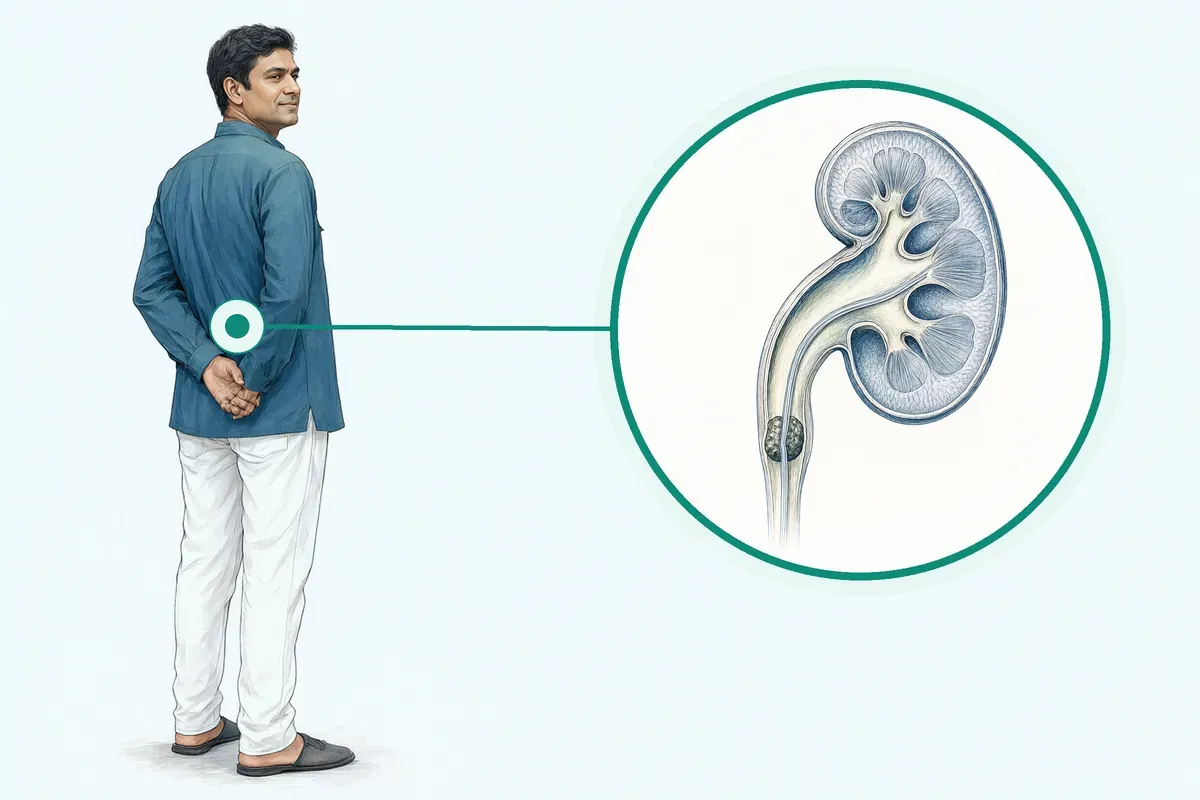
Kidney stones or strictures causing pain? We assess, explain options and plan your care.
- Serving Jaipur since 1991 (35 years)
- NABH accredited
- 24×7 emergency & ICU
- Cashless: RGHS, MAA Yojana, CGHS + 22 insurers
- Procedure time
- 30 minutes to 2 hours
- Anaesthesia
- Spinal or general anaesthesia
- Recovery
- Return to light activity in 3 to 5 days
- Price
- ₹50,000 to ₹2,00,000typical range in India; ask us for an estimate
Stones and strictures disrupt life
Pain, blockage and repeat infections stop you from working and sleeping
Stones can cause severe colic, blood in urine and kidney damage. Strictures make passing urine difficult and lead to infections. Both conditions often return if not treated properly.
-
Sudden severe flank pain
Renal colic from a stuck stone needs urgent relief and often surgical removal.
-
Blood in urine
Visible or microscopic bleeding signals stone movement or tumour and needs evaluation.
-
Weak urine stream
Urethral stricture narrows the passage, causing straining, dribbling and retention.
-
Recurrent infections
Stones and strictures trap bacteria, leading to repeated urinary tract infections.
-
Kidney function at risk
Long-standing obstruction can permanently reduce how well the kidney works.
The incidence and prevalence of urinary stones are rising around the world, including regions that have historically had low rates.
Why Jaipur Hospital
You worry about the next wave of pain, the days off work you cannot afford, and whether the treatment will cost more than you have.
Your care plan
Your first steps with us
- 1 Call or visit OPD for urology consultation
- 2 Complete in-house scans and lab tests
- 3 Agree on the endoscopic procedure and date
- 4 Go home in a day and resume light activity in days
How the operation is done
All procedures use natural passages or a tiny puncture. A scope with a laser or camera reaches the stone, stricture or tumour. No large cuts are made.
-
RIRS (Retrograde Intrarenal Surgery)
Flexible ureteroscope passed through the urethra to the kidney; laser breaks stones into dust or fragments for removal.
-
Mini-PCNL
Small tract made through the skin into the kidney; scope removes larger stones with ultrasonic or laser energy.
-
Ureteroscopic laser lithotripsy
Semirigid scope passed to the ureter or kidney; laser fragments stones; basket removes pieces; stent placed temporarily.
-
Optical internal urethrotomy
Endoscopic knife or laser cuts the stricture open through the urethra; catheter left for a short period.
Why patients trust us
- 1991 Serving Jaipur for 35 years
- NABH Accredited hospital
- 24×7 Emergency, ICU and ambulance
- 25 Cashless schemes and insurers
What research shows about endoscopic stone treatment
-
1 to 2 weeks
Patients undergoing ureteroscopy or shock wave lithotripsy typically resume normal activities within two to three days; PCNL recovery takes one to two weeks.
-
21% to 53%
Stone recurrence after 3 to 5 years ranges from 21% to 53%, so metabolic follow-up matters after clearance.
-
around five percent
In about 5% of ureteroscopies the ureter is too narrow for the scope, requiring a stent and a second sitting.
If it is left untreated
Untreated stones can cause long-term kidney damage, recurrent infections and sepsis. Strictures may lead to complete urinary retention and bladder damage.
Life after treatment
Most people return to normal routine within a week, with stone clearance confirmed on follow-up imaging.
-
Back to work
Most people resume light activity in 3 to 5 days and full work in 1 to 2 weeks.
-
Pass urine freely
Stricture patients usually report a stronger stream and less straining after healing.
-
Stone-free follow-up
Imaging at 4 to 6 weeks confirms clearance; metabolic advice helps lower recurrence risk.
-
Fewer emergency visits
Treated stones and strictures rarely cause sudden colic or retention again.
Meet the team
Our Urology specialists
Care led by Jaipur Hospital's urology consultants, backed by round-the-clock surgical, diagnostic and critical care support.
Frequently asked questions
Questions patients ask about endourology and minimal access surgery
Which problems are assessed under endourology and minimal access surgery?
In short
At Jaipur Hospital, endourology and minimal access surgery covers kidney stones, ureteric stones, urethral strictures, and selected urinary tract tumours. The service uses flexible and semirigid scopes with laser energy to treat these conditions without open incisions. Your surgeon will match the technique to the stone size, stone location, stricture length, and your overall health.
In detail
Evidence shows that active treatment of urolithiasis is currently a minimally invasive intervention using retrograde intrarenal surgery (RIRS), mini-percutaneous nephrolithotomy (mini-PCNL), ureteroscopic laser lithotripsy, and optical internal urethrotomy. Guidelines describe recent recommendations on treatment indications and the choice of modality for ureteral and renal calculi.
For male urethral stricture, successful treatment requires selection of the appropriate endoscopic or surgical procedure based on anatomic location, length of stricture, and prior interventions.
Technological advances have led to the implementation of mini- and micro-PCNL as well as RIRS in the management of kidney stones. All options are minimally invasive with low complication rates.
A common belief
Many people still think open surgery is needed for large stones or strictures.
What actually happens
Current guidelines show that minimally invasive techniques like RIRS, mini-PCNL, and ureteroscopy are now standard for most cases, with lower complication rates and faster recovery.
Your next step at Jaipur Hospital
You will first attend the Urology OPD for a detailed history and examination. The surgeon typically orders low-dose CT or ultrasound to define stone size, location, and stricture characteristics.
After reviewing the images, the surgeon explains which technique suits you and discusses the typical hospital stay of daycare or one night.
How will the doctor decide which tests I need for endourology evaluation?
In short
At Jaipur Hospital, your urologist selects tests based on your symptoms, stone or stricture suspicion, and guideline recommendations. Low-dose computed tomography has become the first choice for detection of ureteral calculi. Routine evaluation includes ultrasound imaging as the first-line modality. In acute disease, low-dose CT is the method of choice. Diagnosis is rapid using low-dose CT.
In detail
Guidelines state that low-dose computed tomography has become the first choice for detection of ureteral calculi. Routine evaluation includes ultrasound imaging as the first-line modality. In acute disease, low-dose CT is the method of choice.
For urethral stricture, routine use of imaging to assess stricture characteristics will be required to apply evidence-based recommendations. Successful treatment of male urethral stricture requires selection of the appropriate endoscopic or surgical procedure based on anatomic location, length of stricture, and prior interventions.
The surgeon may also order basic blood tests such as blood urea nitrogen, complete blood count, and urinalysis to check kidney function and rule out infection before any procedure.
Preoperative imaging helps define stone size, location, and composition, which guides the choice between RIRS, mini-PCNL, ureteroscopic laser lithotripsy, or optical internal urethrotomy.
A common belief
Some patients expect only an X-ray or only an ultrasound.
What actually happens
Current evidence shows low-dose CT gives the most accurate stone details for planning endoscopic surgery, while ultrasound avoids radiation for initial screening. The surgeon picks the right mix for you.
Your next step at Jaipur Hospital
Expect the surgeon to order a low-dose CT or ultrasound at the first visit, along with basic blood and urine tests. Results are usually available the same day from the in-house diagnostic laboratory.
The surgeon will then explain the findings and recommend the next step, whether observation, medical expulsive therapy, or a scheduled endoscopic procedure.
How soon should I expect improvement after endourology or minimal access treatment?
In short
After an endourology or minimal access procedure at Jaipur Hospital, most patients return to light activity within three to five days. Stone-related pain usually improves once the stone fragments are removed or the stricture is opened. If a stent is placed, you may feel urinary urgency or mild discomfort until the stent is removed, typically within one to two weeks.
In detail
Recovery evidence shows that after ureteroscopy or RIRS, patients can go home the same day and resume normal activities within two to three days. After mini-PCNL, a one-night stay is common and normal activities resume in one to two weeks.
Blood in the urine may last for two to three days, sometimes up to a week or two after PCNL. A temporary stent can cause burning, frequency, or flank discomfort; these symptoms settle after stent removal. Drinking plenty of fluids helps clear fragments and reduces burning.
A common belief
Patients often expect instant relief.
What actually happens
In reality, a stent can cause urinary urgency and burning that feels worse than the original stone pain. This is normal and temporary. Full recovery depends on the procedure type and whether a stent is needed.
Your next step at Jaipur Hospital
Plan for three to five days off work for desk jobs and up to two weeks for heavy lifting. Keep your follow-up appointment for stent removal if one was placed. Contact the hospital sooner if you develop fever, heavy bleeding, or inability to pass urine.
How does the term "minimally invasive surgery" relate to endourology and minimal access?
In short
Minimally invasive surgery describes procedures that avoid large open cuts. At Jaipur Hospital, endourology and minimal access surgery use natural body passages or tiny punctures to reach stones, strictures, or tumours. RIRS, mini-PCNL, ureteroscopic laser lithotripsy, and optical internal urethrotomy are all minimally invasive techniques that reduce pain, blood loss, and hospital stay compared with open surgery.
In detail
Evidence confirms that treatment recommendations have shifted to endourologic procedures such as ureteroscopy and percutaneous nephrolithotomy. These interventions are generally associated with shorter recovery times and less discomfort.
Mini-PCNL uses a small tract through the skin, while RIRS and ureteroscopy pass instruments through the urethra without any skin incision. Optical internal urethrotomy opens a stricture endoscopically. All avoid the large flank or abdominal incisions of traditional open surgery.
A common belief
People confuse minimally invasive with non-surgical.
What actually happens
It is still surgery, done under anaesthesia in an operation theatre. But the access is through natural openings or a 5 to 10 mm puncture, not a 10 to 15 cm open incision.
Your next step at Jaipur Hospital
Ask your surgeon which minimally invasive option suits your stone size, location, or stricture type. Most procedures are daycare or need one night in hospital. Recovery to light activity is typically three to five days.
Am I a suitable candidate for a minimally invasive approach for my stone or stricture?
In short
Suitability for a minimally invasive approach at Jaipur Hospital depends on stone size, location, composition, and your overall health. Most patients with stones up to 2 cm, ureteric stones, or urethral strictures are candidates for RIRS, ureteroscopy, mini-PCNL, or optical internal urethrotomy. Your surgeon will assess imaging and medical history to confirm.
In detail
Evidence states that treatment decisions are made individually according to stone size, location, and composition, as well as patient preference and local expertise. Guidelines recommend RIRS as standard therapy for many stones, while mini-PCNL is preferred for larger or complex stones.
Factors such as bleeding disorders, untreated urinary infection, or anatomical abnormalities may influence the choice. The final decision is made after reviewing your CT scan or ultrasound and discussing risks and benefits.
A common belief
Patients often assume everyone gets laser surgery.
What actually happens
Large or complex stones may need mini-PCNL instead of RIRS, and some medical conditions require special preparation. The surgeon tailors the approach to you.
Your next step at Jaipur Hospital
Bring your recent imaging reports to the consultation. The surgeon will explain which technique is appropriate and why. If you have multiple stones, strictures, or prior surgeries, mention them.
How can I decide whether to seek advice about laparoscopic urological surgery?
In short
You should consider seeking advice about laparoscopic urological surgery at Jaipur Hospital if you have a kidney or ureteric condition such as a large stone, a blockage, or a tumour that may need removal through small abdominal incisions. Your GP or urologist can refer you after initial imaging shows the problem.
In detail
Laparoscopic surgery uses a camera and instruments placed through small cuts in the abdomen. It is typically chosen when endoscopic approaches through the urinary tract (such as RIRS or ureteroscopy) are not suitable because of stone size, location, or anatomy.
Evidence shows open and laparoscopic techniques are now restricted to limited indications, with endourologic procedures preferred for most stones.
However, for complex reconstructive cases, large tumours, or when percutaneous access is difficult, laparoscopy offers a minimally invasive alternative to open surgery with less pain and faster recovery than a large incision.
A common belief
Most stones are now cleared with lasers via the natural passage.
What actually happens
Laparoscopy is kept for cases where that route fails or for reconstructive and cancer surgery.
Your next step at Jaipur Hospital
Start with an OPD visit where the surgeon reviews your CT or ultrasound, discusses stone or tumour characteristics, and explains whether laparoscopy, endourology, or another option is appropriate. Procedure time is usually 30 minutes to 2 hours with spinal or general anaesthesia. Recovery to light activity is typically 3 to 5 days.
Which urinary symptoms need urgent assessment?
In short
Urgent assessment at Jaipur Hospital is needed for sudden severe flank pain that does not settle, fever with burning urine, inability to pass urine, visible blood clots in urine, or trauma to the abdomen or back. These may mean a blocked infected kidney, stone stuck in the ureter, or urinary retention. Our 24×7 emergency department evaluates these immediately.
In detail
Evidence states acute renal colic due to ureteral stone obstruction is an emergency requiring immediate pain management. Obstruction with infection can cause sepsis. Retention can damage the bladder and kidneys. Visible blood may indicate tumour or severe stone disease.
Low-dose CT is the first choice for detecting ureteral calculi in acute settings. Ultrasound is first line for stable patients. Prompt imaging and blood tests guide urgent decompression or stone removal.
A common belief
People often wait out severe pain or treat fever at home.
What actually happens
A blocked infected kidney can turn septic in hours. Retention can ruin the bladder. Our emergency team gives pain relief, scans, and urology review within minutes.
Your next step at Jaipur Hospital
If you have any of these symptoms, go to the emergency department or call the ambulance service. Bring an attendant. The team will start pain relief, fluids, and imaging within minutes. Urology cover is available round the clock. For non-urgent symptoms like mild frequency or occasional discomfort, book a routine OPD appointment.
Which symptoms should prompt me to see a urology specialist for endourology evaluation?
In short
You should see a urology specialist at Jaipur Hospital if you have severe flank or abdominal pain that comes in waves, blood in your urine, difficulty passing urine, a weak stream, or recurrent urinary infections. Stones in the renal calices can remain asymptomatic, but typical colic symptoms usually bring patients to the OPD. Acute renal colic due to ureteral stone obstruction is an emergency that requires immediate pain management.
In detail
Most patients with urolithiasis present with typical colic symptoms, but stones in the renal calices remain asymptomatic. Acute renal colic due to ureteral stone obstruction is an emergency that requires immediate pain management.
Urethral stricture often presents with a weak urinary stream, straining to void, incomplete emptying, or recurrent infections. Guidelines for male urethral stricture recommend routine evaluation with imaging to assess stricture characteristics before deciding on endoscopic or surgical treatment.
Dietary habits, westernised dietary habits, less fluid intake, and climatic factors like hot temperature and many hours of exposure to sunshine play a crucial role in the development of stones. The incidence of urolithiasis reaches its peak in population aged over 30 years.
A common belief
Some people wait hoping stones will pass on their own.
What actually happens
While small ureteral stones can pass with medical expulsive therapy, larger stones or strictures often need endoscopic removal. Delaying can lead to infection or kidney damage.
Your next step at Jaipur Hospital
If you notice any of these symptoms, attend the Urology OPD at Jaipur Hospital. The surgeon will take a focused history, examine you, and usually order a low-dose CT or ultrasound as first-line imaging. Based on the findings, the surgeon will discuss whether observation, medical expulsive therapy, or an endoscopic procedure is appropriate.
How will the results change my care plan for endourology and minimal access surgery?
In short
Test results at Jaipur Hospital directly shape your care plan by confirming stone size, location, composition, and stricture details, and by checking kidney function and infection status. Large or impacted stones may need mini-PCNL or RIRS, while small ureteric stones might be managed with observation or medical expulsive therapy. Stricture length and location determine whether optical internal urethrotomy is suitable.
In detail
Guidelines state that treatment decisions are made individually according to stone size, location, composition, and patient preference. If CT shows a stone larger than 10 mm in the kidney, RIRS or mini-PCNL is typically considered. For ureteric stones, semirigid ureteroscopy with laser is common.
If urine culture shows infection, antibiotics are given before any endoscopic procedure. Impaired renal function may alter anaesthesia choice or require staged treatment. The surgeon balances the advantages and disadvantages of each technique based on the imaging and lab findings.
Your next step at Jaipur Hospital
After results are available, the urologist will explain which endoscopic procedure fits your condition, the expected hospital stay, and the cost range. You will also discuss anaesthesia preference and stent placement if needed.
What should I do if symptoms persist or worsen after endourology or minimal access treatment?
In short
If symptoms persist or worsen after an endourology or minimal access procedure at Jaipur Hospital, contact the urology team immediately. Warning signs include fever with chills, heavy bleeding or clots in the urine, severe flank or abdominal pain not relieved by prescribed medicines, inability to pass urine, or burning that gets worse after the first few days.
In detail
Evidence lists complications such as infection, bleeding, ureteral injury, stricture formation, or retained stone fragments. A stent can cause significant discomfort, sometimes more than the procedure itself. If a drainage tube was placed, pain should decrease after its removal.
Persistent symptoms may indicate a urine leak, blockage, or infection needing prompt evaluation. Do not stop antibiotics early if prescribed. The hospital's 24-hour emergency department is equipped to assess and manage these issues.
A common belief
Some discomfort and blood-tinged urine are normal for a few days.
What actually happens
But worsening symptoms are not. Patients sometimes wait too long, thinking it is part of healing. Early review prevents serious complications like sepsis or kidney damage.
Your next step at Jaipur Hospital
Keep the emergency numbers handy: 0141-2551500, 0141-2554139, +91-7414-001-001. Visit the 24×7 emergency department at Jaipur Hospital if you develop any warning signs, especially at night. Bring your discharge summary and stent details.
FAQ library
Questions and answers about endourology and minimal access surgery
When you contact us
Get your assessment and plan
Contact Jaipur Hospital for a urology OPD consultation, in-house tests, clear options, a cost estimate and cashless scheme help.
- A consultation with a urologist in the OPD
- Your scans and reports reviewed, with tests done in-house if you need them (laboratory, X-ray and imaging)
- Your options explained in plain words, including whether you need surgery at all
- A cost estimate before you decide
- Help with cashless treatment under RGHS, MAA Yojana, CGHS and empanelled insurers and TPAs
- Follow-up visits after your treatment
Overview
Endourology and Minimal Access Surgery: what to know
What Endourology and Minimal Access Surgery treats
- 75% to 90% Calcium oxalate stones
- 5% to 20% Uric acid stones
- Over 30 years Peak age for stones
Endourology and Minimal Access Surgery covers scarless laser and endoscopic procedures for stones, strictures, and tumours of the urinary tract. Stones form when substances in the urine such as calcium oxalate become concentrated and crystallise. Calcium oxalate makes up 75% to 90% of stones, followed by uric acid at 5% to 20% and other minerals in smaller proportions.
The incidence of urinary stones is rising worldwide, including in regions that historically had low rates. Stones peak in people aged over 30 years. Genetic changes at specific loci may contribute to the formation of different kinds of calculi. Climate warming, dietary changes, and obesity are common theories explaining the rising trend.
Dietary habits such as westernised diets and low fluid intake, together with hot climates and long sun exposure, play a crucial role in stone development. Strictures are narrowings of the urethra that can result from injury, infection, or previous procedures. Tumours in the urinary tract may also be managed with endoscopic techniques.
Management of urinary stones is a major issue for most urologists. Technological advances have led to the implementation of mini- and micro-percutaneous nephrolithotomy (PCNL) as well as retrograde intrarenal surgery (RIRS). These interventions are minimally invasive with low complication rates. Active treatment of urolithiasis is currently a minimally invasive intervention.
Symptoms and warning signs that need urgent care the same day
- Fever with chills and flank pain
- High fever after procedure
- Heavy bleeding after procedure
- Cannot pass urine after procedure
- Worsening pain after procedure
Most patients with urolithiasis present with typical colic symptoms, but stones in the renal calices can remain asymptomatic. Acute renal colic due to ureteral stone obstruction is an emergency that requires immediate pain management.
You may feel:
- Severe pain in the flank or lower abdomen
- Nausea
- Vomiting
- Blood in the urine
If you have a fever with chills along with flank pain, this suggests an infection that needs same-day care. After a laser or endoscopic procedure, you may have a burning feeling when you urinate for several hours. You may feel the urge to go even if you do not need to.
You may have some blood in your urine for 2 or 3 days. Small amounts of blood in the urine can persist for a week or two after percutaneous procedures. Call your healthcare provider right away if you develop high fever, heavy bleeding, inability to pass urine, or worsening pain.
Causes and who is at higher risk
- 21% to 53% Stone recurrence rate
- 3 to 5 years Recurrence timeframe
Stones develop when urine contains more crystal-forming substances than the fluid can dilute. Low fluid intake and westernised dietary habits increase this risk. Hot temperatures and many hours of sun exposure also contribute. Obesity and climate warming are linked to the rising incidence of stones.
A genetic mutation at a specific locus may contribute to the formation of different kinds of calculi. The recurrence rate of urolithiasis ranges from 21% to 53% after 3 to 5 years.
Strictures can follow:
- Urethral trauma
- Infection
- Previous endoscopic procedures
Tumours have their own risk factors such as smoking and chemical exposure. Your surgeon will review your history to understand what may have led to your condition.
How urinary stones and strictures are diagnosed
Routine evaluation includes ultrasound imaging as the first-line modality. In acute disease, low-dose computed tomography (CT) is the method of choice. Low-dose CT has become the first choice for detection of ureteral calculi. Diagnosis is rapid using low-dose CT.
Your doctor may also recommend imaging tests such as CT scan, ultrasound, or X-ray to get a better view of the kidneys and the stone. For strictures, routine use of imaging to assess stricture characteristics is required to apply evidence-based recommendations.
Successful treatment of male urethral stricture requires selection of the appropriate endoscopic or surgical procedure based on anatomic location, length of stricture, and prior interventions. Before any procedure, you will meet with your healthcare provider who will review all of your options with you.
Treatment options without surgery and when surgery is advised
RIRS
- RIRS Flexible scope through urethra for complex kidney stones
Mini-PCNL
- Mini-PCNL Small skin puncture for larger kidney stones
Conservative observational management of renal stones is possible. Medical expulsive therapy (MET) for ureteral stones can support spontaneous passage in the absence of complicating factors. Pharmacological treatment may promote spontaneous stone passage. MET is recommended to support spontaneous stone expulsion. Active treatment might not be necessary, especially for stones in the lower pole.
For stones in the lower pole of the kidney, treatment may be postponed if there are no complaints. Oral chemolysis is an option for uric acid stones. Surgery may be recommended if a stone is too large to pass, becomes stuck in the ureter, or does not pass for another reason.
Surgery may be advised if the stone causes too much pain or leads to infection. Treatment decisions are made individually according to stone size, location, and if known composition, as well as patient preference and local expertise. RIRS is generally suggested in cases of complex kidney stones.
Healthcare providers usually suggest a percutaneous nephrolithotomy when other kidney stone treatments do not work or are not possible. If less invasive procedures fail, other surgery types may be suggested to remove stones, although this is rarely necessary. If you have a large stone, you may need to come back for more treatments.
Your surgeon will advise which technique suits you among options such as:
- RIRS
- Mini-PCNL
- Ureteroscopic laser lithotripsy
- Optical internal urethrotomy
Preparing for Endourology and Minimal Access Surgery
Do
- Tell doctor all medicines
- Stop eating after midnight
- Bring reports and insurance cards
- Bring an attendant
Before your procedure, your surgeon will review all of your options with you. You will usually meet the team and have imaging tests such as a CT scan, ultrasound, or X-ray to get a clear view of the stone or stricture. Low-dose CT is often the first choice for detecting ureteral stones. Ultrasound is commonly used as a first-line test. Blood tests and a urine test may also be done to check kidney function and rule out infection.
Tell your doctor about every medicine you take, including blood thinners such as aspirin. Your doctor will tell you if you need to stop any medicine before surgery and when to start it again. You should not eat or drink anything after midnight on the night before your surgery. If you must take essential medicines, take them with only a small sip of water.
On the day of surgery, wear loose, comfortable clothes. Bring any test reports, your insurance or scheme cards (RGHS, MAA Yojana, CGHS, or private TPA cards), and a list of your current medicines. An attendant should come with you to help after discharge. The hospital has a 24-hour pharmacy and diagnostic lab on site if any last-minute tests are needed.
How Endourology and Minimal Access Surgery Is Done
- Anaesthesia Spinal or general anaesthesia given
- Scope insertion Small scopes passed through natural openings or tiny skin puncture
- Stone break or removal Laser breaks stone or scope removes fragments
- Stent or drain placed Temporary stent in ureter or drainage tube after Mini-PCNL
Endourology and Minimal Access Surgery uses small scopes passed through natural body openings or a tiny skin puncture. No large cuts or stitches are needed. Your surgeon will advise which technique suits your stone size, location, and your overall health.
Retrograde Intrarenal Surgery (RIRS) uses a flexible ureteroscope passed through the urethra and bladder up into the kidney. A laser breaks the stone into dust or small pieces. Mini-PCNL makes a small tract through the skin into the kidney to remove larger stones. Ureteroscopic laser lithotripsy uses a semirigid scope for stones in the ureter. Optical internal urethrotomy makes a small cut inside the urethra to open a stricture.
On the day of surgery, you will receive spinal or general anaesthesia. You will not be awake, will not move, and will not feel pain during the procedure. The operation usually takes 30 minutes to 2 hours. A temporary plastic stent is often placed in the ureter after stone procedures to keep urine draining while swelling settles.
A drainage tube may be left after Mini-PCNL. Stone pieces may be sent to the lab to find out what they are made of. Calcium oxalate is the most common stone type.
Risks and Possible Complications of Endourology and Minimal Access Surgery
- Infection
- Can occur after any endoscopic procedure
- Ureteral injury or stricture
- Narrowing can happen after ureteroscopy
- Residual fragments
- Some stone pieces may be left behind needing another procedure
- Ureter too narrow
- In about 5 percent of cases the ureteroscope cannot pass
- Organ injury
- Rare risk with PCNL
All operations carry some risk. In studies, the following complications have been reported:
- Infection can occur after any endoscopic procedure.
- Bleeding: you may see blood in your urine for a few days after ureteroscopy or for a week or two after PCNL. Significant blood loss needing a transfusion is a known risk of PCNL.
- Ureteral injury or stricture (narrowing) can happen after ureteroscopy.
- Some stone fragments may be left behind and may need another procedure.
- In about 5 percent of cases, the ureter is too narrow for the ureteroscope.
- Injury to nearby organs is a rare risk with PCNL.
Pain is common after these procedures. Most people report moderate pain. The stent, if placed, can be the most uncomfortable part. Your doctor will prescribe pain relievers. Pain usually improves after the stent or drainage tube is removed. Contact the hospital at once if you have heavy bleeding, fever, severe pain not helped by medicines, or cannot pass urine.
Recovery and Aftercare After Endourology and Minimal Access Surgery
After a brief observation period, you can usually go home the same day after ureteroscopy or laser lithotripsy. After Mini-PCNL, a stay of one night is typical. You can return to light activity in 3 to 5 days.
For the first few days, you may have a burning feeling when you pass urine. You may feel the urge to go often, even if little urine comes out. Drinking plenty of water helps. Your doctor may give medicine to numb the burning (phenazopyridine), which can turn urine orange or red — this is normal.
If antibiotics are prescribed, take the full course even if you feel better. Eat your normal diet. If you have kidney, heart, or liver disease and must limit fluids, ask your doctor before increasing how much you drink.
A stent is usually removed at an office visit 2 to 10 days after surgery. Avoid heavy lifting and strenuous activity for the first week or two. Most people return to work or school in about a week; if your job is physically demanding, two weeks off may be better.
A check-up is usually scheduled 4 to 6 weeks after the procedure. Call the hospital if you develop fever, heavy bleeding, severe pain, or cannot pass urine.
Results of Endourology and Minimal Access Surgery
In studies, endourologic procedures show high success rates. The success rate for percutaneous nephrolithotomy is reported as about 75% to 98%. PCNL techniques provide higher stone-free rates than RIRS, but with higher complication rates, more blood loss, and longer admission times. RIRS provides higher stone-free rates than mini-percutaneous procedures (MIPPs). RIRS is considered standard therapy for many stones.
Treatment can be tailored by balancing the advantages and disadvantages of each technique. Most stone fragments that are not removed pass out of the body within 24 hours, though sometimes it can take many weeks. If less invasive procedures fail, other surgery types may be suggested, although this is rarely necessary.
Stone recurrence is common. The recurrence rate of urolithiasis ranges from 21% to 53% after 3 to 5 years. Your doctor may advise dietary changes and high fluid intake to lower the chance of new stones. Oral chemolysis is an option for uric acid stones.
Cost and Insurance for Endourology and Minimal Access Surgery in Jaipur
The typical price range for Endourology and Minimal Access Surgery in India is ₹50,000 to ₹2,00,000.
The final cost depends on the technique used (RIRS, Mini-PCNL, ureteroscopy, or urethrotomy), the size and number of stones, whether a stent or drainage tube is needed, the type of anaesthesia, the length of hospital stay (daycare or one night), and any pre-operative tests such as CT, ultrasound, MRI, or blood work.
RIRS is considered a medical necessity and is covered under insurance. Jaipur Hospital is empanelled under RGHS, MAA Yojana, CGHS, and a panel of private insurers and TPAs. Bring your scheme or insurance card on the day of admission. The hospital has an in-house pharmacy and diagnostic lab, so test and medicine costs are included in the final bill. Ask the hospital for an estimate before admission.