

Orthopaedics · Jaipur Hospital
Back Pain and Spinal Deformity in Jaipur
Persistent back or leg pain limiting your day. We assess, explain options, and plan your next steps.
- Serving Jaipur since 1991 (35 years)
- NABH accredited
- 24×7 emergency & ICU
- Cashless: RGHS, MAA Yojana, CGHS + 22 insurers
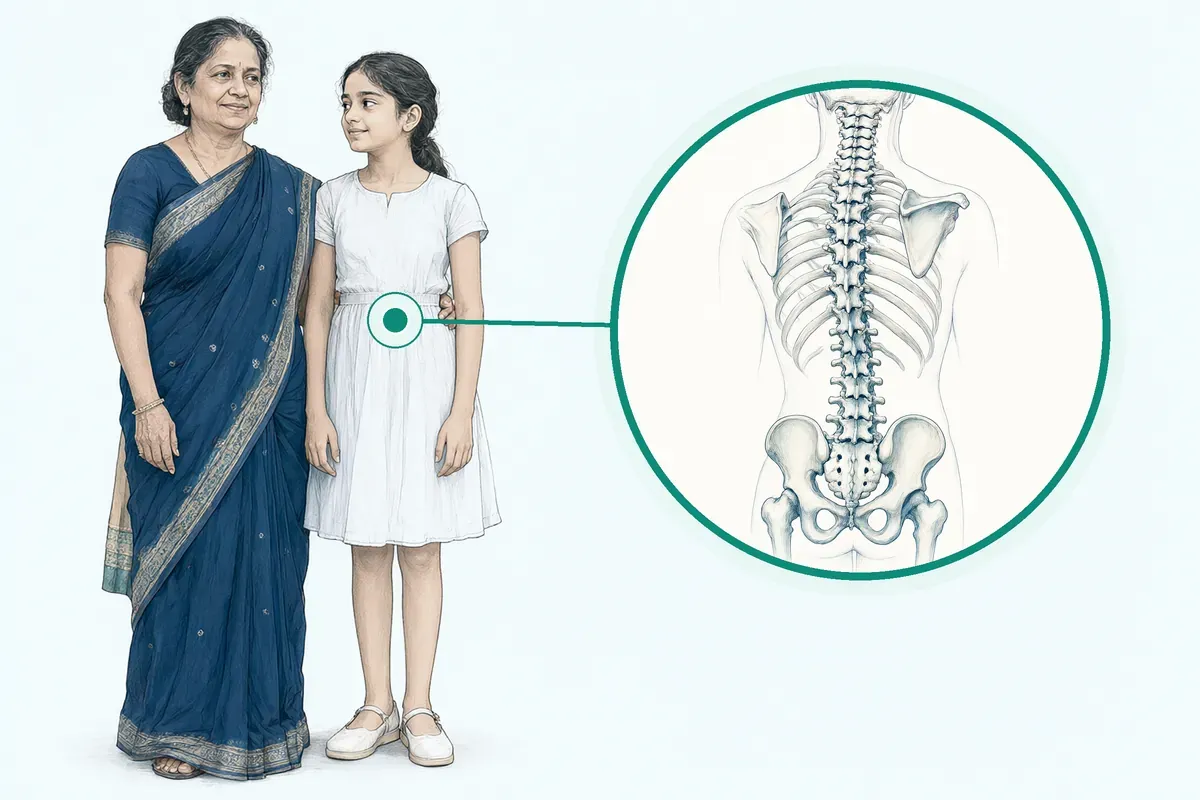
- Operation time
- 2 to 5 hours
- Anaesthesia
- General anaesthesia
- Recovery
- Back to light activity in 4 to 6 weeks
- Price
- ₹1,50,000 to ₹4,50,000typical range in India; ask us for an estimate
Back pain stops your routine
Pain, stiffness, or a visible curve that makes walking, sitting, or working hard
You may feel aching in the lower back, shooting pain down the leg, numbness, or notice a change in posture. Standing or walking often makes it worse; sitting or bending forward can relieve it.
-
Leg pain with walking
Pain or heaviness in the buttocks or legs after a short distance, eased by sitting or bending forward.
-
Numbness or weakness
Tingling, loss of sensation, or foot drop that makes daily tasks unsafe.
-
Posture change
A visible curve, uneven shoulders, or leaning forward that worsens over time.
-
Sleep and work disrupted
Pain at night, difficulty concentrating, and days missed from work or household duties.
Lumbar spinal stenosis affects over 100 million people worldwide and is the most common reason for spinal surgery after age 65.
Why Jaipur Hospital
You worry the pain will never settle, that surgery might leave you worse, or that the cost and time off work will burden your family.
Your care plan
Your first steps with us
- 1 Call or visit OPD for a surgeon consultation
- 2 Get scans and tests done in-house if needed
- 3 Review options and a cost estimate with your surgeon
- 4 Have surgery and follow-up visits for recovery
How the operation is done
Surgery is under general anaesthesia and usually takes 2 to 5 hours. The surgeon decompresses nerves and, if needed, stabilises the spine with screws, cages, or cement. Hospital stay is typically 3 to 5 nights.
-
Microdiscectomy
Minimally invasive removal of the disc fragment pressing on a nerve, often for sciatica.
-
Spinal Fusion (TLIF/PLIF)
Stabilises unstable segments using screws, cages, and bone graft to stop abnormal movement.
-
Deformity Correction (Osteotomy)
Realignment of the spine for scoliosis or kyphosis by cutting and reshaping bone.
-
Vertebroplasty/Kyphoplasty
Cement injected into a collapsed vertebra to stabilise osteoporotic fractures and reduce pain.
Why patients trust us
- 1991 Serving Jaipur for 35 years
- NABH Accredited hospital
- 5 Orthopaedics consultants
- 24×7 Emergency, ICU and ambulance
- 25 Cashless schemes and insurers
What studies show about surgical treatment
-
About 7 in 10 patients
In a trial, 71% with decompression alone and 73% with decompression plus fusion achieved a 30% improvement in disability scores at follow-up.
-
Re-operation in 19%
Among 190 patients followed for 2 to 8 years, 19% needed another surgery, most often for persistent pain.
-
Deep infection 5 to 10%
Studies report 5 to 10% of patients develop deep infections months to years after instrumented fusion, usually needing further surgery.
If it is left untreated
Without treatment, symptoms often persist or slowly worsen. About one-third improve on their own, half stay the same, and 10 to 20% report worse pain and walking ability over three years.
Life after treatment
Most people return to light activity within 4 to 6 weeks. You can expect less leg pain, better walking distance, and a clearer plan for daily movement.
-
Walk further
Most people find they can walk longer distances before leg pain or heaviness forces them to stop.
-
Sleep better
Night pain often settles after the nerve pressure is relieved, so rest improves within weeks.
-
Return to routine
Light household work and desk duties usually resume by 4 to 6 weeks; heavier lifting takes longer.
-
Follow-up support
Scheduled clinic visits and physiotherapy guidance help you rebuild strength safely at your own pace.

Frequently asked questions
Questions patients ask about back pain and spinal deformity
Which problems are assessed under back pain and spinal deformity?
In short
Jaipur Hospital assesses a wide range of spinal disorders under this service. These include degenerative disc disease, herniated discs, spinal stenosis, spondylolisthesis, adult scoliosis, kyphosis, and osteoporotic vertebral fractures. The team also evaluates failed back surgery syndrome and post-traumatic spinal instability.
In detail
The evaluation covers conditions that affect the structure and function of the spine. Evidence shows that adult spinal deformity often involves the thoracic or thoracolumbar spine through the ageing process.
Lumbar spinal stenosis is a clinical syndrome of pain in the buttocks or lower extremities, with or without back pain. Degenerative scoliosis and iatrogenic flatback are the most usual causes of spinal deformity in adults.
The surgical team uses physical examination, gait and posture analysis, and radiological assessment integrated with risk stratification indices to establish optimal treatment planning.
Your next step at Jaipur Hospital
You will attend an OPD consultation where the surgeon takes a detailed history and examines your spine. Imaging such as X-rays or MRI is usually arranged within a few days. Based on the findings, the surgeon discusses whether non-surgical care or a procedure is appropriate.
How will the doctor decide which tests I need?
In short
The surgeon at Jaipur Hospital selects tests based on your history, physical examination, and suspected diagnosis. Common tests include standing X-rays of the whole spine, MRI for soft tissue and nerve detail, CT scan for bony anatomy, and sometimes nerve conduction studies or bone density scans.
In detail
The decision follows a structured approach. Evidence shows physical examination with focus on gait and posture, along with radiological assessment, are primarily used and integrated with risk stratification indices to establish optimal treatment planning.
For lumbar spinal stenosis, diagnosis is generally made based on clinical history of back and lower extremity pain provoked by lumbar extension, relieved by lumbar flexion, and confirmed with cross-sectional imaging. Standing X-rays show alignment and instability.
MRI is the standard for visualising disc herniation, stenosis, and nerve compression. CT gives better bony detail for surgical planning in deformity. Bone density (DEXA) is checked if osteoporotic fracture is suspected. The surgeon orders only the tests that will change management.
A common belief
Patients often ask for every scan upfront.
What actually happens
But each test answers a specific question. Ordering only what is needed avoids unnecessary radiation, cost, and delay.
Your next step at Jaipur Hospital
After your OPD consultation, the surgeon writes the imaging requests. Most scans are done in-house at Jaipur Hospital, often on the same day or within 1 to 2 days. Results are reviewed at a follow-up visit or by phone. The surgeon then explains the findings and next steps.
How soon should I expect improvement after spinal surgery?
In short
At Jaipur Hospital, improvement after spinal surgery varies by procedure and patient. Many patients notice reduced leg pain within days of decompression surgery, while back pain and strength recover over weeks. Fusion procedures typically need longer for bone healing. Your surgeon will give a timeline matched to your operation and health.
In detail
Evidence shows that decompression for lumbar spinal stenosis often relieves leg symptoms quickly, but functional scores such as the Oswestry Disability Index improve steadily over months.
In studies comparing decompression alone with decompression plus fusion, both groups showed similar outcomes at two and five years, with ODI scores around 24 to 27.
Recovery to light activity usually takes four to six weeks, while heavy lifting and sport may need three to six months. Factors like age, smoking, diabetes, and the number of levels operated on affect speed of recovery.
A common belief
Many people expect instant relief, but studies show functional scores improve gradually over six to twelve months.
What actually happens
Rushing back to heavy work can delay healing or cause re-injury.
Your next step at Jaipur Hospital
Plan for a hospital stay of three to five nights and arrange an attendant for the first week at home. Follow the physiotherapy programme from day one, walk regularly, and avoid bending, lifting more than two kilograms, or twisting for the first six weeks. Attend all follow-up visits so the team can check wound healing, fusion progress, and nerve recovery.
Do the scan findings explain my spinal symptoms?
In short
At Jaipur Hospital, scan findings are matched with your history and examination to confirm which changes cause your symptoms. Many adults have degenerative changes on imaging without pain. Your surgeon correlates the level of stenosis, spondylolisthesis, or deformity with your specific pain pattern, walking distance, and neurological signs before recommending treatment.
In detail
Evidence shows that radiological lumbar spinal stenosis appears in 11 percent of asymptomatic people and up to 38 percent of the general population on imaging, while clinical syndrome prevalence is 11 to 39 percent. This mismatch means imaging alone cannot diagnose the pain source.
Clinical diagnosis relies on history of buttock or leg pain provoked by extension and relieved by flexion, confirmed by cross-sectional imaging. Physical examination focusing on gait, posture, and neurological deficit integrates with imaging and risk stratification indices to plan treatment. Incidental findings are common and do not always need intervention.
A common belief
Many people assume every abnormality on MRI needs fixing.
What actually happens
Studies show 11 to 38 percent of asymptomatic adults have radiological stenosis. Treating imaging instead of the patient can lead to unnecessary surgery.
Your next step at Jaipur Hospital
Bring all prior scans and reports to your consultation. The surgeon will review images, perform a focused examination, and explain which findings correlate with your symptoms. Further tests such as nerve conduction studies or diagnostic injections may be used if uncertainty remains.
How can I decide whether to seek advice about back pain?
In short
You should seek advice about back pain at Jaipur Hospital when the pain lasts more than a few weeks, limits your daily activities, or comes with warning signs such as leg weakness, numbness, or bladder and bowel changes. Most back pain improves with simple measures, but persistent or worsening symptoms need a proper evaluation to rule out serious causes.
In detail
Evidence shows that first-line management includes activity modification, simple analgesia, and physical therapy. If these do not help after 4 to 6 weeks, or if you have red flags like unexplained weight loss, fever, history of cancer, or trauma, you should see a specialist.
Imaging is not routinely needed early on but may be ordered if symptoms persist or neurological signs appear. The orthopaedic and neurosurgery teams at Jaipur Hospital assess your history, examine gait and posture, and order targeted investigations only when clinically indicated.
Your next step at Jaipur Hospital
Start by booking an OPD appointment at Jaipur Hospital. Bring any previous X-rays or MRI reports. The doctor will take a detailed history, examine you, and advise whether you need further tests, physiotherapy, or a surgical opinion. Early assessment prevents delays in treatment if surgery is required.
How will treatment affect my walking, movement, or independence?
In short
Spinal treatment aims to improve walking, movement, and independence by relieving nerve compression and stabilising the spine. At Jaipur Hospital, the surgical team selects the procedure based on your specific diagnosis. Decompression for stenosis typically improves walking distance. Fusion for instability or deformity may reduce spinal flexibility but can enhance overall function by reducing pain and preventing collapse. Most patients return to light activity within four to six weeks.
In detail
Evidence shows decompression surgery improves leg pain and walking ability more than non-operative care in the short term. For stenosis with spondylolisthesis, adding fusion did not yield better disability scores at two or five years.
However, deformity correction restores sagittal balance, which correlates with better standing and walking posture. Fusion eliminates motion at the operated segments, reducing side-bending by twenty to sixty percent. Adjacent segments compensate but may develop degenerative changes over time. Rehabilitation focuses on core strength, gait retraining, and adaptive strategies to maintain independence.
A common belief
Some expect full flexibility after fusion.
What actually happens
The fused segments lose motion permanently. Adjacent segments take more load, which can cause future stiffness. Realistic expectations matter.
Your next step at Jaipur Hospital
Walking usually resumes the day after surgery with assistance. By four to six weeks, most patients walk independently for short distances. Full recovery of endurance takes three to six months. A walking aid may be needed temporarily. Your physiotherapist will set progressive goals.
Which symptoms should prompt me to see a specialist?
In short
You should see a specialist if you have persistent back or neck pain lasting more than a few weeks, pain radiating down the leg or arm, numbness or tingling in the limbs, weakness in the legs or feet, difficulty walking or standing for long periods, or a visible curve or hump in the spine.
In detail
These symptoms suggest nerve compression or structural deformity. Evidence shows lumbar spinal stenosis is often exacerbated by standing, walking, or lumbar extension and relieved by forward flexion, sitting, or recumbency.
The clinical syndrome includes pain in the buttocks or lower extremities with or without back pain. Neurogenic claudication — leg pain brought on by walking and relieved by sitting — is a hallmark.
Progressive neurological deficit, such as foot drop or worsening weakness, warrants timely evaluation. The surgeon correlates these symptoms with imaging findings to determine the severity.
A common belief
People often ignore leg pain that comes on with walking, thinking it is just ageing.
What actually happens
But neurogenic claudication is a classic sign of stenosis that needs proper assessment, not just painkillers.
Your next step at Jaipur Hospital
If you notice any of these symptoms, do not wait for them to worsen. Contact Jaipur Hospital to schedule an OPD appointment. The surgeon will examine you, order appropriate imaging, and explain the findings. Early assessment helps decide if conservative care or surgery is needed.
How will the results change my care plan?
In short
The imaging and test results at Jaipur Hospital directly guide whether you need non-surgical care, a minimally invasive procedure, or major reconstructive surgery. They show the exact level and severity of nerve compression, instability, or deformity, which determines the technique and urgency.
In detail
Results change the plan by confirming the diagnosis and quantifying the pathology. Evidence shows that for lumbar spinal stenosis, decompression surgery plus fusion did not result in better clinical outcomes at 2 and 5 years than decompression alone in selected patients.
However, fusion may be added for instability or deformity. The Oswestry Disability Index scores were similar between fusion and decompression-alone groups at 2 years (27 vs 24) and 5 years.
Radiological findings such as spondylolisthesis, degree of stenosis, sagittal balance, and bone quality alter the surgical approach. For example, osteoporotic fractures may be treated with vertebroplasty or kyphoplasty, while rigid deformities need osteotomy. The surgeon matches the procedure to the pathology.
A common belief
A common belief is that worse-looking scans always mean bigger surgery.
What actually happens
But studies show decompression alone can work as well as fusion for many stenosis patients, so the surgeon matches the operation to the specific pathology, not just the scan appearance.
Your next step at Jaipur Hospital
Once your reports are ready, the surgeon discusses them with you in detail. You will receive a clear explanation of what the images show and the recommended options.
If surgery is advised, you will get information on the typical hospital stay of 3 to 5 nights and recovery to light activity in 4 to 6 weeks.
What should I do if symptoms persist or worsen after spinal treatment?
In short
At Jaipur Hospital, contact your surgeon promptly if leg pain, numbness, weakness, or back pain return or increase after treatment. New bowel or bladder changes, saddle numbness, or progressive leg weakness need same-day assessment. The team will review imaging, check for infection, implant issues, or recurrent compression, and adjust your plan.
In detail
Evidence indicates that re-operation rates after spinal surgery range from 19 percent within two to eight years for degenerative conditions, with pain being the primary reason.
Infections can appear months to years later, affecting five to ten percent of patients at 11 to 45 months post-surgery. Neurological deficits may result from vascular, metabolic, or mechanical complications.
Persistent symptoms do not always mean surgery failed; they may reflect adjacent-level degeneration, non-union, or scar tissue. A structured review with imaging and clinical examination guides the next step, which may include medication optimisation, targeted physiotherapy, injections, or revision surgery.
A common belief
Some patients wait months hoping symptoms settle, but early review catches treatable causes like infection or non-union.
What actually happens
Studies show up to 19 percent need re-operation within eight years, often for pain.
Your next step at Jaipur Hospital
Keep a symptom diary noting time, activity, and severity. Do not stop prescribed medicines without advice. Attend scheduled follow-ups at two weeks, six weeks, three months, and one year. If red-flag symptoms appear, call the hospital emergency line or visit the 24-hour emergency department.
Which symptoms suggest pressure on the spinal cord or urgent nerve damage?
In short
At Jaipur Hospital, symptoms needing urgent evaluation include progressive leg weakness, numbness in the saddle area (inner thighs, buttocks, perineum), loss of bladder or bowel control, and difficulty starting or stopping urination. Severe, unrelenting back pain with fever may indicate infection. These require same-day assessment in the emergency department.
In detail
Evidence describes neurological deficits after spine surgery including partial or total paraplegia, quadriplegia, or peripheral nerve deficit from vascular, metabolic, or mechanical complications. Cauda equina syndrome from massive disc herniation, tumour, or haematoma presents with saddle anaesthesia, bladder retention or incontinence, and bilateral leg weakness.
Spinal cord compression in the thoracic or cervical region causes upper motor neuron signs: spasticity, hyperreflexia, Babinski sign, and gait disturbance. Early decompression improves recovery chances. Infection may manifest months to years later with pain, fever, and wound changes. Deep infection rates of five to ten percent at 11 to 45 months have been reported.
A common belief
Patients often dismiss saddle numbness or urinary difficulty as unrelated.
What actually happens
These are classic cauda equina signs where hours matter for nerve recovery. Delayed treatment can cause long-term paralysis.
Your next step at Jaipur Hospital
If you develop any red-flag symptom, do not wait for a routine appointment. Call the hospital emergency line or attend the 24-hour emergency department immediately. Bring your surgical notes and recent imaging. The team will arrange urgent MRI, blood tests, and surgical review.
FAQ library
Questions and answers about back pain and spinal deformity
When you contact us
Get your assessment and plan
Contact Jaipur Hospital for an OPD consultation with an orthopaedic surgeon, in-house tests, a clear explanation of options, and a cost estimate before you decide.
- A consultation with an orthopaedic surgeon in the OPD
- Your scans and reports reviewed, with tests done in-house if you need them (laboratory, X-ray and imaging)
- Your options explained in plain words, including whether you need surgery at all
- A cost estimate before you decide
- Help with cashless treatment under RGHS, MAA Yojana, CGHS and empanelled insurers and TPAs
- Follow-up visits after your treatment
Overview
Back Pain and Spinal Deformity: what to know
What back pain and spinal deformity is and how it happens
- Normal spine
- Vertebrae with discs as cushions
- Stenosis
- Narrow canal compresses nerves
- Flatback
- Spine left too straight after surgery
- Degenerative scoliosis
- Uneven wear of discs and joints
Back pain and spinal deformity cover a range of conditions that change the shape or function of the spine. The spine is made of bones called vertebrae, separated by discs that act as cushions. Nerves run through the spinal canal and branch out to the legs and body. When the canal narrows, nerves can get compressed.
This is called lumbar spinal stenosis. It is a clinical syndrome of pain in the buttocks or lower extremities, with or without back pain. The condition is often exacerbated by standing, walking, or lumbar extension and relieved by forward flexion, sitting, or recumbency.
Adult spinal deformity affects the thoracic or thoracolumbar spine throughout the ageing process. The most usual causes of spinal deformity in adults are iatrogenic flatback and degenerative scoliosis. Iatrogenic flatback can happen after earlier spine surgery that leaves the spine too straight. Degenerative scoliosis develops as discs and joints wear down unevenly over time.
Lumbar spinal stenosis is associated with reduced space available for the neural and vascular elements of the lumbar spine. In each spinal surgery case there is an irreversible loss of the normal active range of movement in the spinal column. When compared with control subjects, the ability of surgical patients to side flex was reduced by 20–60%. The post surgical rigid spine causes strain on the un-fused parts of the skeletal framework.
Symptoms of back pain and spinal deformity and warning signs that need urgent care the same day
- Loss of bladder or bowel control
- Numbness in groin or inner thighs
- Progressive leg weakness
Common symptoms include pain in the back, buttocks, or legs that gets worse with standing or walking and improves when you sit or bend forward. You may feel heaviness, numbness, or tingling in the legs. Walking distance often becomes shorter over time. In lumbar spinal stenosis, pain is provoked by lumbar extension and relieved by lumbar flexion.
Warning signs that need urgent care the same day include sudden loss of bladder or bowel control, numbness in the groin or inner thighs (saddle area), and progressive weakness in one or both legs. These suggest severe nerve compression that can lead to lasting damage if not decompressed quickly.
Symptoms of neurological damage post-surgery include partial or total paraplegia, quadriplegia, or peripheral nerve deficit. Neurological deficits can result from vascular, metabolic, or mechanical complications of spine surgery. If you notice any of these, go to the emergency department without delay.
Causes and who is at higher risk for back pain and spinal deformity
- Stenosis
- Reduced space for nerves and blood vessels
- Osteoporotic fractures
- Fractures change spinal alignment
The most usual causes of spinal deformity in adults are iatrogenic flatback and degenerative scoliosis. Degenerative changes in discs and facet joints can lead to narrowing of the spinal canal. Lumbar spinal stenosis is associated with reduced space available for the neural and vascular elements of the lumbar spine.
Previous spine surgery can alter the balance of the spine and lead to flatback syndrome. Osteoporotic fractures can change spinal alignment.
Risk factors include older age, as the prevalence of the clinical syndrome of lumbar spinal stenosis increases with age. Lumbar spinal stenosis is the most common reason for spinal surgery in patients over 65 years. Clinical care is complicated by high rates of anatomic stenosis on imaging studies in older people who are completely asymptomatic.
Heterogeneity of the condition and lack of standard criteria for diagnosis also make clinical assessment harder. A growing elderly population increases the need for careful evaluation.
How back pain and spinal deformity is diagnosed: examination and tests
- 11% Asymptomatic radiological stenosis
- 25% Clinical diagnosis in primary care
Diagnosis starts with a detailed history and physical examination. The doctor checks your gait, posture, and range of movement. Physical examination, with a focus on gait and posture, along with radiographical assessment are primarily used and integrated with risk stratification indices to establish optimal treatment planning.
The diagnosis of lumbar spinal stenosis can generally be made based on a clinical history of back and lower extremity pain that is provoked by lumbar extension, relieved by lumbar flexion, and confirmed with cross-sectional imaging.
Imaging usually includes X-rays of the whole spine in standing position to see alignment, and MRI to show nerves, discs, and soft tissues. CT scans may be used for bone detail. Because many older adults have stenosis on imaging without symptoms, the clinical picture must match the scan findings.
The pooled prevalence of lumbar spinal stenosis based on radiological diagnosis in the asymptomatic population was 11%. In primary care patients, the mean prevalence based on clinical diagnosis was 25%. Your surgeon will correlate your symptoms with the images to decide if the findings explain your problem.
Treatment options without surgery for back pain and spinal deformity, and when surgery is advised
- approximately one-third Reported improvement
- approximately 50% Reported no change
- 10% to 20% Reported worsening
Non-surgical management is the first line for most patients.
Options include:
- Drugs
- Physiotherapy
- Spinal injections
- Lifestyle modification
- Multidisciplinary rehabilitation
First-line therapy is activity modification, analgesia, and physical therapy. Nonoperative treatment includes activity modification such as reducing periods of standing or walking, oral medications to diminish pain such as nonsteroidal anti-inflammatory drugs (NSAIDs), and physical therapy. Most patients with lumbar spinal stenosis are treated nonoperatively.
A systematic review concluded that there is insufficient evidence to recommend any specific type of non-surgical treatment. Long-term benefits of epidural steroid injections for lumbar spinal stenosis have not been demonstrated.
In a series of patients followed up for up to 3 years without operative intervention, approximately one-third reported improvement, approximately 50% reported no change in symptoms, and approximately 10% to 20% reported that their back pain, leg pain, and walking were worse. In a randomised trial, decompressive laminectomy improved symptoms more than nonoperative therapy on the Oswestry Disability Index.
Surgery appears effective in carefully selected patients with back, buttock, and lower extremity pain who do not improve with conservative management. Given that rapid deterioration is rare and symptoms often wax and wane or gradually improve, surgery is almost always elective and considered only if sufficiently bothersome symptoms persist despite trials of less invasive interventions.
Selected patients with continued pain and activity limitation may be candidates for decompressive surgery. Among patients with lumbar spinal stenosis, with or without degenerative spondylolisthesis, decompression surgery plus fusion surgery did not result in better clinical outcomes at 2 years and 5 years than did decompression surgery alone.
Your surgeon will discuss which technique suits you:
- Microdiscectomy for nerve compression
- Spinal fusion (TLIF/PLIF) for instability
- Deformity correction (osteotomy) for scoliosis or kyphosis
- Vertebroplasty/kyphoplasty for osteoporotic fractures
Preparing for back pain and spinal deformity surgery
Do
- Regular medicines
- List of allergies
- Comfortable loose clothing
- Non-slip slippers
- Walking aid you use
Before surgery you will have a pre-anaesthesia check-up. This usually includes blood tests, a chest X-ray, an ECG and sometimes an MRI or CT scan of the spine to confirm the plan. Tell your surgeon and anaesthetist about every medicine you take, especially blood thinners, diabetes tablets or insulin, and any herbal supplements.
Your doctor will tell you which medicines to stop and when. You must not eat or drink for at least six hours before the operation; clear water may be allowed up to two hours before if the anaesthetist agrees. Bring your regular medicines, a list of allergies, comfortable loose clothing, non-slip slippers and any walking aid you use. An attendant should stay with you during the hospital stay.
How back pain and spinal deformity surgery is done
The operation is performed under general anaesthesia and usually takes two to five hours. Your surgeon will choose the technique that matches your condition. Microdiscectomy is a minimally invasive removal of the part of a disc that presses on a nerve. Spinal fusion (TLIF or PLIF) joins two or more vertebrae with screws and cages to stop painful movement.
Deformity correction (osteotomy) cuts and realigns bone for scoliosis or kyphosis. Vertebroplasty or kyphoplasty injects bone cement into a collapsed vertebra from osteoporosis. On the day of surgery you will be taken to the modular operation theatre, given anaesthesia, and positioned face down on a special table.
The surgeon makes the incision, carries out the planned procedure, and closes the wound with stitches or staples. A drain may be left for a day. You will wake up in the recovery area and then move to a ward or the ICU for monitoring.
Risks and possible complications of back pain and spinal deformity surgery
- less than 1% Death rate in healthy patients
- 20 to 60% Reduction in side-bending ability
- 19% Re-operation within two to eight years
All spinal operations carry risks. In studies, fusion surgery is linked to more blood loss, higher infection rates, longer hospital stays and higher costs than decompression alone. The reported death rate for otherwise healthy patients is less than 1%. In one series of 447 patients, two deaths were due to pulmonary complications.
Neurological injury such as paraplegia, quadriplegia or peripheral nerve deficit can occur from vascular, metabolic or mechanical causes. Implant-related problems include migration of bone graft into the spinal canal and nerve root compression by implants. Every spinal surgery causes an irreversible loss of normal active range of movement in the fused segments.
Side-bending ability can be reduced by 20 to 60% compared with people who have not had surgery. The rigid fused segment puts extra strain on the unfused parts of the spine. In a severe case this led to stress fractures of the pelvis. Degenerative changes at adjacent levels are common and can appear within two years in adults.
A higher degree of correction is linked to a higher rate of degenerative osteoarthritis. Deep wound infection may appear months or years later; 5 to 10% of patients developed deep infection at 11 to 45 months after surgery. Treating such infections usually needs further surgery to remove implants and clean the wound.
Infection can also be transmitted through blood transfusions or allograft bone. Pain is the main reason for re-operation. In one group of 190 patients, 19% needed re-operation within two to eight years. Among 34 patients with significant post-surgical pain, 56% reported reduced pain after additional surgery.
Graft-site pain was reported by 24% of 87 patients, and 15% said it interfered with daily activities. Complication rates vary widely between studies, from 0 to 89%. Your surgeon will discuss the risks that apply to your specific procedure and health.
Recovery and aftercare after back pain and spinal deformity surgery
After the operation you will spend a few hours in the recovery room and then move to a ward. Pain is managed with a multimodal plan that may include intravenous medicines, tablets and sometimes a patient-controlled pump. A urinary catheter and the wound drain are usually removed within 24 to 48 hours.
You are encouraged to sit up and walk short distances with assistance on the first or second day. A physiotherapist will teach you safe ways to move, get in and out of bed, and use a walking aid if needed. The typical hospital stay is three to five nights.
Before discharge you will get instructions on wound care, signs of infection (redness, swelling, fever, discharge), medication timings and activity limits. At home, avoid bending, twisting and lifting more than two to three kilograms for the first six weeks. Light activity such as walking indoors is encouraged and gradually increased.
Most people return to light daily activity in four to six weeks. Stitches or staples are removed at the follow-up visit, usually around two weeks.
Call the hospital or visit the emergency department if you develop:
- Fever above 38°C
- Increasing wound pain or discharge
- New numbness or weakness in the legs
- Difficulty passing urine
- Sudden severe back pain
- Calf swelling and pain
Results of back pain and spinal deformity surgery
In a large trial of patients with lumbar spinal stenosis, with or without degenerative spondylolisthesis, decompression plus fusion did not give better clinical outcomes at two years and five years than decompression alone.
The mean Oswestry Disability Index score at two years was 27 in the fusion group and 24 in the decompression-alone group, a difference that was not statistically significant. Walking distance on the six-minute walk test was also similar (397 metres versus 405 metres). Results were similar whether spondylolisthesis was present or not.
In another randomised trial of 94 participants, decompressive laminectomy improved symptoms more than non-operative therapy, with a mean difference of 7.8 points on the Oswestry Disability Index. Among persons with lumbar spinal stenosis and spondylolisthesis, lumbar fusion increased symptom resolution in one trial by 5.7 points on the physical dimension of the 36-Item Short Form Health Survey.
Without surgery, about one-third of patients report improvement over three years, about 50% report no change, and 10% to 20% report worsening of back pain, leg pain and walking ability. Surgical outcomes are generally favourable compared with continued non-operative care. Your surgeon will explain what improvement you can reasonably expect for your specific condition.
Cost and insurance for back pain and spinal deformity surgery in Jaipur
The typical price range for spinal surgery in India is ₹1,50,000 to ₹4,50,000. The final cost depends on the technique used, the number of levels operated, the type of implants, the length of hospital stay, and whether you need ICU care. Jaipur Hospital is a NABH-accredited multispeciality hospital established in February 1991.
It accepts:
- RGHS
- MAA Yojana
- CGHS
- A panel of private insurers and TPAs
The hospital has a 24×7 emergency department, modular operation theatres, an in-house pharmacy, diagnostic laboratory and imaging, and a physiotherapy department for post-operative rehabilitation. Ask the admissions desk for an estimate based on your planned procedure and insurance coverage.