Plastic Surgery · Jaipur Hospital
Facial Palsy Surgery in Jaipur
One-sided facial weakness makes daily life hard. We assess you and give a clear plan.
- Serving Jaipur since 1991 (35 years)
- NABH accredited
- 24×7 emergency & ICU
- Cashless: RGHS, MAA Yojana, CGHS + 32 insurers
- Operation time
- 4 to 8 hours
- Anaesthesia
- General anaesthesia
- Recovery
- Physiotherapy for 6 to 12 months
- Price
- ₹2,00,000 to ₹5,00,000typical range in India; ask us for an estimate
Face does not move right
One side of your face feels heavy, droops, or will not smile
You may not close your eye fully. Food collects in your cheek. Speaking feels different. People stare or ask what happened. You avoid photos and social events.
-
Eye does not close
The eyelid stays open, causing dryness, irritation, and risk to vision.
-
Mouth pulls to one side
Smiling looks uneven. Drooling can happen. Speech may be less clear.
-
Unwanted movements appear
The eye closes when you smile, or the mouth moves when you blink.
-
Face feels tight or heavy
Muscles on the weak side feel stiff or pull in wrong directions.
Up to 55 percent of patients with facial nerve palsy have incomplete recovery.
Why Jaipur Hospital
You worry that your face will never look like yours again and that people notice the asymmetry before they hear what you say.
Your care plan
Your first steps with us
- 1 Call or visit OPD for first consult
- 2 Surgeon reviews scans and plans surgery
- 3 Operation under general anaesthesia, 5 to 7 nights stay
- 4 Physiotherapy for 6 to 12 months at home
How the operation is done
Surgery reconnects nerves or moves a muscle to restore smile and eye closure. The method depends on how long the nerve has been injured and what function remains.
-
Cross-facial nerve graft
A nerve from the working side of the face is tunnelled across to the paralysed side to carry signals for a smile.
-
Gracilis free flap transfer
A small muscle from the inner thigh, with its nerve and blood vessels, is transplanted to the face to create a new smile.
-
Temporalis muscle transfer
The chewing muscle on the side of the head is rotated down to the corner of the mouth to give immediate movement.
-
Static sling suspension
Fascia or suture is used to lift the drooping corner of the mouth and support the eyelid for symmetry at rest.
Why patients trust us
- 1991 Serving Jaipur for 35 years
- NABH Accredited hospital
- 1 Plastic Surgery consultants
- 24×7 Emergency, ICU and ambulance
- 35 Cashless schemes and insurers
What research shows about this treatment
-
6 to 12 months for nerve recovery
Studies note final movement appears between three months and one year as nerves regenerate slowly.
-
Attractiveness penalty of 2.5 points
Observers rated paralysed faces lower; surgery reduced this penalty by nearly one full standard deviation.
-
Smile may need bite to activate
Depending on the donor nerve used, some patients must clench the jaw to smile until retraining helps.
If it is left untreated
Without treatment the eye stays exposed, risking corneal damage and vision loss. The mouth remains uneven, affecting speech and eating. Unwanted muscle movements can worsen over time.
Life after treatment
Most people see gradual improvement in symmetry and movement over months with dedicated therapy.
-
Better eye closure
The eyelid protects the eye more naturally, reducing dryness and irritation.
-
More even smile
The corner of the mouth lifts with expression, making social interaction easier.
-
Less unwanted movement
Therapy helps separate eye and mouth actions so they work independently.
-
Confidence in daily life
Most people return to work and social settings without hiding their face.
Meet the team
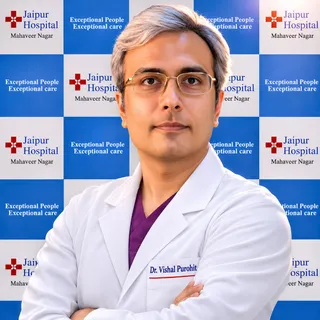
Your plastic surgery doctors
Explore our plastic surgery hospital in Jaipur: every treatment, the doctors and what to expect at your visit.
Frequently asked questions
Questions patients ask about facial palsy surgery
What does facial reanimation surgery involve?
In short
Facial reanimation surgery at Jaipur Hospital aims to restore movement and symmetry to a paralysed face. The operation takes four to eight hours under general anaesthesia. A typical hospital stay is five to seven nights. The surgical team selects from several techniques based on your specific condition.
In detail
The surgical team may use a cross-facial nerve graft, which routes a donor nerve from the unaffected side of the face to the paralysed side.
Another option is a gracilis free flap transfer, where a small muscle from the inner thigh is transplanted to the face with its nerve and blood supply. A temporalis muscle transfer rotates a local chewing muscle to the corner of the mouth.
A static sling suspension uses fascia or suture to support the face at rest. Evidence shows these procedures can improve both function and appearance, helping you express yourself more naturally again. Rehabilitation with specialised physiotherapy for six to twelve months is essential after surgery to retrain the facial muscles.
A common belief
Many people think one operation fixes everything instantly.
What actually happens
In reality, the nerves grow slowly. You will not see movement for months. Dedicated physiotherapy for six to twelve months is what teaches your face to move again.
Your next step at Jaipur Hospital
You will meet your surgeon for a detailed evaluation of the cause, duration and severity of your paralysis. The team will explain which technique suits your anatomy and goals. Physiotherapy begins soon after discharge and continues for months. The typical cost range in India is ₹2,00,000 to ₹5,00,000; ask us for an estimate.
Which tests and scans do I need before facial reanimation surgery?
In short
Before facial reanimation surgery at Jaipur Hospital, the surgeon orders tests based on your history and examination findings. Routine blood work and imaging are not always required for typical Bell's palsy, but they are indicated if you have risk factors, atypical features or no recovery within four months. The evaluation focuses on nerve function, muscle viability and eye health.
In detail
The initial assessment includes a comprehensive clinical examination of the head, neck, eyes, ears, mouth and neurological system. Electrophysiological studies such as nerve conduction velocity and electromyography help distinguish between axonotmesis and neuropraxia, showing whether the facial muscles are still viable for reinnervation.
Imaging like MRI or CT may be needed if a tumour, stroke or structural lesion is suspected. Ophthalmological evaluation checks corneal sensitivity, Bell's phenomenon, lagophthalmos and lid retraction to grade the risk of corneal damage.
The surgeon also assesses the degree of nerve lesion and the coordination between both sides of the face. These findings guide the choice between nerve transfer, nerve graft, muscle transfer or static procedures.
A common belief
Patients often expect a long list of scans.
What actually happens
In straightforward Bell's palsy with no recovery in four months, the key tests are nerve studies and an eye exam. Extra imaging is reserved for atypical cases.
Your next step at Jaipur Hospital
Bring any previous test reports, imaging or nerve study results to your consultation. The surgeon will explain which additional tests you need and why. Most preoperative investigations are done in-house at our diagnostic laboratory and radiology department.
How painful is facial palsy surgery and the early recovery?
In short
Facial palsy surgery at Jaipur Hospital is done under general anaesthesia, so you feel no pain during the 4 to 8 hour operation. After surgery, you can expect moderate discomfort, swelling and bruising on the face and, if a gracilis flap is used, on the thigh donor site. The care team gives regular pain relief to keep you comfortable.
In detail
Evidence shows that swelling and minor bruising are common for the first two weeks. You will be asked to keep dressings in place for 72 hours, then you may shower normally. Ice packs and sleeping with the head raised on several pillows help reduce swelling.
All sutures dissolve over 10 to 14 days and do not need removal. Pain is usually well controlled with oral medication; severe pain is uncommon and should be reported at once.
The operation may involve incisions that leave visible scars, but these typically fade over months. Nerve transfers or muscle transfers do not cause lasting difficulty with chewing, speaking or tongue movement because of natural nerve redundancy.
A common belief
People often imagine severe, lasting pain.
What actually happens
In reality, most patients describe it as soreness and tightness that improves steadily with simple measures like ice and head elevation.
Your next step at Jaipur Hospital
Avoid heavy lifting or strenuous activity for two weeks or until your surgeon clears you at the post-operative visit. Take prescribed pain medicine on schedule for the first few days. Physiotherapy starts early and continues for 6 to 12 months to retrain facial muscles.
How long does recovery usually take after facial palsy surgery?
In short
Recovery after facial palsy surgery at Jaipur Hospital involves a hospital stay of 5 to 7 nights. Swelling and bruising settle in the first two weeks. Sutures dissolve over 10 to 14 days. Nerve regeneration and muscle re-education continue for 6 to 12 months, with physiotherapy throughout. Final dynamic results appear between three months and one year depending on the procedure.
In detail
Evidence shows that after nerve transfer or gracilis free flap transfer, nerves grow slowly, so movement returns gradually. You will keep the face and leg wrapped for 72 hours, then shower normally. Ice and head elevation reduce swelling for the first 48 hours.
Avoid heavy lifting for two weeks. Specialised physical therapy helps retrain facial muscles, build strength, and support long-term results. Rehabilitation is always necessary after surgery and focuses on coordination and muscle timing.
A common belief
People often think the surgery itself creates the smile.
What actually happens
In reality, the operation connects the nerve and muscle; the smile comes from months of daily physiotherapy. Without therapy, even a perfect operation gives a poor result.
Your next step at Jaipur Hospital
Plan for weekly or fortnightly physiotherapy sessions for at least six months. Attend all surgical follow-ups at 2 weeks, 6 weeks, 3 months, 6 months, and 12 months. Continue daily home exercises as prescribed.
How will tendon, nerve, or muscle damage be assessed for facial palsy surgery?
In short
At Jaipur Hospital, the surgical team assesses nerve, muscle, and tendon function through a detailed clinical examination and specialised tests. This includes checking facial movement at rest and during expression, testing corneal sensation, and measuring the degree of eyelid closure. Electrophysiological studies such as nerve conduction studies and electromyography (EMG) are used to evaluate the viability of the facial nerve and muscles.
In detail
The initial evaluation follows a comprehensive protocol: accurate clinical history, ophthalmological, otological, oral, and neurological examination to exclude secondary causes. Nerve conduction studies and EMG help distinguish between neurapraxia, axonotmesis, and neurotmesis, which guides the choice of procedure.
For example, EMG biofeedback studies have shown that electrodiagnosis is essential to select patients for specific rehabilitation or surgical protocols. Imaging such as MRI or CT may be ordered if a tumour, stroke, or structural lesion is suspected.
The team also evaluates the donor nerves, such as the masseteric or hypoglossal nerve, to ensure they are healthy for transfer. This multidisciplinary assessment ensures the procedure matches the pattern and severity of your paralysis.
A common belief
A simple look at the face is not enough.
What actually happens
Two patients can look similar but have very different nerve injuries. Only electrodiagnostic testing shows whether the muscle is still alive and which donor nerve will works well.
Your next step at Jaipur Hospital
You will undergo a thorough clinical examination in the OPD, followed by any recommended nerve studies or imaging. The surgeon will explain the findings and how they influence the surgical plan. This assessment typically takes one or two visits.
How will appearance, function, and realistic expectations be discussed for facial palsy surgery?
In short
At Jaipur Hospital, the surgical team discusses appearance, function, and realistic expectations during a detailed pre-operative consultation. The surgeon explains which aspects of facial movement can be restored, such as smile symmetry, eyelid closure, and resting tone, and which may remain limited. You will review the planned technique, the expected timeline for nerve regeneration, and the essential role of post-operative physiotherapy.
In detail
Evidence shows that facial reanimation surgery improves attractiveness and decreases negative perception, with studies reporting normalisation of gaze patterns and reduced attentional distraction from facial asymmetry. However, results are not immediate; final outcomes may take three months to one year as nerves regenerate.
The smile may not be fully spontaneous if a donor nerve like the masseteric nerve is used, requiring you to bite down to activate it. Therapy is needed to learn activation without clenching the jaw. Scars from incisions are expected, though they usually fade.
The team uses pre-operative photographs and, where appropriate, 3-D facial analysis to plan and later assess outcomes. An independent panel and patient self-assessment are part of the standardised evaluation process.
A common belief
Many patients expect an instant, perfect smile.
What actually happens
In reality, nerve growth takes months, the smile may need a conscious trigger like biting, and therapy is essential. We make sure you know this before you decide.
Your next step at Jaipur Hospital
You will have time to ask questions about typical results. The surgeon will outline the recovery milestones, the 6 to 12 months of physiotherapy, and the possibility of revision surgery.
Why might my doctor recommend facial reanimation surgery?
In short
Your doctor may recommend facial reanimation surgery at Jaipur Hospital if you have facial paralysis, weakness or asymmetry that has not recovered on its own. The procedure can improve eyelid closure, restore a more balanced smile and help you express emotions more naturally. Surgery is considered when the facial muscles are unlikely to recover without help.
In detail
Common causes include Bell's palsy, Ramsay Hunt syndrome, trauma, stroke, nerve tumours or congenital conditions. If the paralysis has lasted more than a year, the facial muscles may waste away. Nerve transfer surgery can prevent this atrophy when done early, preserving long-term outcomes.
The surgeon may reroute a healthy nerve such as the masseteric nerve for chewing or the hypoglossal nerve for tongue movement to the paralysed facial nerve branches. For longer-standing paralysis, a gracilis free muscle transfer brings new muscle to the face.
Static procedures like a sling or eyelid weight give immediate symmetry at rest. Evidence shows reanimation surgery improves attractiveness and reduces negative perception of the paralysed face. The decision depends on the cause, duration, severity and your overall health.
A common belief
Some believe you must operate immediately or never.
What actually happens
Evidence shows the ideal window is twelve to eighteen months, but good results are still seen up to two years. Even later, static procedures can improve symmetry at rest.
Your next step at Jaipur Hospital
Your surgeon will assess how long the paralysis has been present and whether the facial muscles are still viable. Early evaluation within twelve to eighteen months is ideal, though good results are possible up to twenty-four months. Even after that, options exist. The team will discuss risks such as infection, scarring or the need for revision surgery.
How should I prepare in the days before facial reanimation surgery?
In short
In the days before facial reanimation surgery at Jaipur Hospital, your surgical team will give you specific instructions. You will need to stop certain medicines that increase bleeding risk. Arrange for an attendant to stay with you during the five to seven night hospital stay and to take you home after discharge. Prepare loose, comfortable clothing that opens at the front.
In detail
The surgeon will review all your current medicines, supplements and herbal products. Blood thinners, antiplatelet drugs and certain supplements like ginkgo, garlic or vitamin E may need to be stopped several days before surgery. You will meet the anaesthesia team for a preoperative assessment.
If you smoke, stopping at least two weeks before surgery improves wound healing and reduces complications. The physiotherapy team may teach you some exercises to start after surgery. You will be asked to sign consent forms after all your questions are answered. On the day of surgery, you will meet your surgeon again to confirm the plan and sign final paperwork.
A common belief
Many patients forget to stop herbal supplements that thin the blood.
What actually happens
Others do not plan for an attendant. Both can delay surgery. The team gives you a clear checklist so nothing is missed.
Your next step at Jaipur Hospital
Follow the fasting instructions given by the anaesthesia team. Pack essentials for a five to seven night stay including toiletries, regular medicines and a front-opening shirt. Ensure your attendant knows the discharge plan. The team will call you with the exact admission time.
What are the common side effects and the less common serious complications of facial palsy surgery?
In short
Common side effects after facial palsy surgery at Jaipur Hospital include facial swelling, bruising, temporary numbness at donor sites, and a scar at each incision. Less common serious complications include infection, bleeding, flap failure, nerve injury, and the need for revision surgery.
In detail
Evidence shows most patients have swelling and minor bruising for two weeks. Donor nerve grafts from the ankle or neck may leave a small patch of long-term numbness but no functional loss. Serious risks include haematoma, lymphoedema, and ecchymosis.
With free flap transfer, there is a risk of flap loss requiring urgent return to theatre. Nerve transfers can cause unwanted movements while eating (usually mild) or a smile that requires biting down to activate. Synkinesis (involuntary linked movements) may develop during nerve regeneration. Scarring varies by individual healing. The team discusses all risks specific to your chosen technique.
A common belief
Patients often worry most about the scar.
What actually happens
The bigger functional risks are synkinesis during nerve regrowth or a smile that isn't spontaneous. The team monitors these closely in follow-up.
Your next step at Jaipur Hospital
Follow wound care instructions, keep dressings dry for 72 hours, and attend all follow-ups. Seek urgent care for sudden swelling, bleeding, fever, or loss of flap colour. Physiotherapy for 6 to 12 months helps manage synkinesis.
Which symptoms are expected after facial palsy surgery and which need urgent medical attention?
In short
After facial palsy surgery at Jaipur Hospital, expected symptoms include facial and thigh swelling, mild bruising, temporary numbness near incisions, and moderate discomfort for one to two weeks. Urgent symptoms are sudden severe swelling, fever above 38°C, wound discharge or bleeding, loss of sensation or movement that was present after surgery, and signs of flap failure such as colour change or coolness of the transferred muscle.
In detail
Evidence shows that dressings stay on for 72 hours, then you may shower normally. Ice packs and head elevation for 48 hours minimise swelling. All sutures dissolve over 10 to 14 days. Avoid heavy lifting for two weeks.
Synkinesis, or unwanted linked movements, may appear months later during nerve regeneration and is managed with therapy or botulinum toxin. If a nerve graft was taken from the ankle or neck, a small patch of numbness there is normal and usually not disabling.
The smile may require biting down to activate if a masseteric nerve transfer was used; therapy helps make this more automatic.
Any sudden change in the operated side, especially in the first weeks, should be reported immediately to rule out haematoma, infection or vascular compromise of a free flap.
A common belief
Patients sometimes wait days with a fever or a changing flap colour, hoping it will settle.
What actually happens
Early reporting saves flaps and prevents serious infection. When in doubt, call the hospital immediately.
Your next step at Jaipur Hospital
Keep the 24-hour emergency number handy. Attend the post-operative check at 7 to 10 days and all physiotherapy sessions. Do not ignore new pain, redness spreading from the wound, or a sudden drop in facial movement.
FAQ library
Questions and answers about facial palsy surgery
When you contact us
Get a clear plan for your face
Contact Jaipur Hospital for an OPD consultation with a plastic surgeon who will review your reports and explain your options.
- A consultation with a plastic surgeon in the OPD
- Your scans and reports reviewed, with tests done in-house if you need them (laboratory, X-ray and imaging)
- Your options explained in plain words, including whether you need surgery at all
- A cost estimate before you decide
- Help with cashless treatment under RGHS, MAA Yojana, CGHS and empanelled insurers and TPAs
- Follow-up visits after your treatment
Overview
Facial Palsy Surgery: what to know
What facial palsy is and how it happens
- Facial nerve damage
- Stops signals to face muscles
- Narrow bony canal
- Swelling or pressure blocks signals
- Common causes
- Bell's palsy, Ramsay-Hunt, trauma
- Facial reanimation
- Surgery to restore movement and balance
Facial palsy means weakness or loss of movement on one side of the face. It happens when the facial nerve is damaged. The nerve carries signals from the brain to the muscles that control smiling, blinking and other expressions. When the nerve does not work, the muscles on that side become flaccid and cannot move.
The facial nerve travels through a narrow bony canal in the skull. Swelling, pressure or a cut along this path can stop the signals. In many people the cause is Bell's palsy, which is a sudden inflammation of the nerve.
Other causes include:
- Ramsay-Hunt syndrome
- Lyme disease
- Stroke
- Nerve tumours
- Head and neck cancer
- Facial trauma
- Autoimmune disease
Some people are born with facial paralysis. Others develop it after an injury, infection, inflammation or a neurological condition such as stroke.
Facial reanimation is the surgical process of trying to restore dynamic, spontaneous symmetry to the paralysed face. Surgery aims to bring back movement and balance so you can express yourself more naturally again.
Symptoms of facial palsy and warning signs that need urgent care the same day
- Cannot close eye fully Cornea can dry out and be damaged
- Lower lid turns outward Called ectropion, adds to eye exposure
The main symptom is weakness or loss of movement, usually on one side of the face. You may not be able to smile, raise your eyebrow or close your eye on that side.
Facial paralysis often affects both eyelids, which can make it difficult to close the eye fully. This is called lagophthalmos. The lower lid may turn outward (ectropion). If the eye cannot close, the cornea can dry out and become damaged. This needs urgent attention the same day.
Some people develop synkinesis. This is an abnormal involuntary movement that happens when you try to move another part of the face. For example, the eye may close when you smile. Common types are oral-ocular synkinesis and ocular-oral synkinesis. Synkinesis usually begins three to four months after the nerve starts to regenerate and can continue for up to two years.
Other symptoms include a drooping corner of the mouth, difficulty keeping food in the mouth while chewing, and changes in tear or saliva production. The face may look asymmetric at rest and during movement.
Causes of facial palsy and who is at higher risk
- 9 to 55 percent Incomplete recovery
- up to 70 percent Bell's palsy full recovery
The most common causes are Bell's palsy, Ramsay-Hunt syndrome and trauma, including surgical trauma.
Other causes include:
- Lyme disease
- Stroke
- Nerve tumours
- Head and neck cancer
- Facial trauma
- Autoimmune disease
Facial paralysis can also be an inborn condition or result from damage to the facial nerve from injury, infection, inflammation or neurological conditions like stroke.
Incomplete recovery of facial nerve palsy is reported in 9 to 55 percent of patients. Spontaneous complete recovery of Bell's palsy occurs in up to 70 percent of cases.
Facial muscles are small and delicate with few internal sensory receptors. They are at high risk of contracture and changes in movement pattern. Asymmetry is not only due to muscle weakness but also to poor coordination between the two sides of the face.
People who have had acoustic neuroma surgery often develop facial nerve palsy, which remains the most common indication for facial nerve rehabilitation. If you have a condition that affects the facial nerve or have had surgery near the nerve, you are at higher risk of lasting paralysis.
How facial palsy is diagnosed: examination and tests
- Clinical history and exam
- Head, neck, eye, ear, mouth, nerve check
- Eye assessment
- Checks lid closure, Bell's phenomenon, corneal sensitivity, lid retraction
- Electrodiagnostic tests
- Assess nerve lesion degree; guide surgery decision
The initial evaluation includes an accurate clinical history followed by a comprehensive examination of the head and neck. This includes ophthalmological, otological, oral and neurological examination to exclude secondary causes.
Routine laboratory testing and diagnostic imaging are not indicated in patients with new-onset Bell's palsy. However, they should be performed in patients with risk factors, atypical cases or in any case without resolution within four months.
Ophthalmologists play a pivotal role in the multidisciplinary team involved in the evaluation and rehabilitation of these patients. The care team checks how well the eye closes, the quality of the Bell's phenomenon (upward movement of the eye when trying to close the lid), corneal sensitivity and the degree of lid retraction.
Electrodiagnostic tests may be used to assess the degree of nerve lesion. These help decide whether the nerve injury is likely to recover on its own or whether surgery may be needed. Many factors are involved in determining the appropriate treatment: the underlying cause, expected duration of nerve dysfunction, anatomical manifestations, severity of symptoms and objective clinical findings.
Treatment options without surgery, and when surgery is advised
In the acute phase, the main priority is to ensure adequate corneal protection.
This may include:
- Taping the eyelid overnight
- Lubricating drops
- Ointment
- Botulinum toxin injection
- Tarsorrhaphy (partial closure of the eyelids)
- Eyelid weight implants
- Scleral contact lenses
- A palpebral spring
Physical therapy, specifically neuromuscular retraining, is a useful intervention for treating facial nerve palsy. Mime therapy or biofeedback therapy may help with control, reducing synkinesis and improving symmetry. EMG biofeedback has been shown to be more effective than mirror biofeedback in some studies. Rehabilitation is always necessary after surgery. Coordination and muscle timing should form the main components of treatment.
Botulinum toxin injections can reduce unwanted facial movements (synkinesis) that sometimes develop after paralysis. By relaxing overactive muscles, it helps improve facial balance and symmetry.
Surgery is advised when the facial muscles still work but are not expected to recover on their own. It is usually recommended to perform nerve transfer surgery within 12 to 18 months after the onset of paralysis. Good results are still possible up to 24 months afterward. Even if more than a year has passed, you still have treatment options.
Surgery can be most effective when performed within the first year after nerve injury for maximum facial muscle viability. Acting early can also protect the eye if paralysis makes it difficult to close the eyelid. Nerve transfer surgery can prevent facial muscle atrophy when done early, preserving long-term outcomes.
Your surgeon will advise which technique suits you. Options include cross-facial nerve graft, gracilis free flap transfer, temporalis muscle transfer and static sling suspension. Some procedures restore symmetry at rest (static reanimation), while others bring back movement and expression (dynamic reanimation).
The choice depends on the cause, duration of paralysis, your age, overall health and the condition of the facial muscles.
Preparing for facial palsy surgery
Do
- Tell doctor all medicines Include blood thinners, herbals, supplements
- Arrange an attendant To stay with you and take you home
Your surgeon will explain the procedure that suits your condition and answer your questions before the day of surgery. You will have a physical examination and may need blood tests, imaging or nerve studies to plan the operation.
Tell your doctor about every medicine you take, including blood thinners, herbal products and supplements, so they can advise which ones to stop or continue. Because the operation uses general anaesthesia, you must not eat or drink for at least six hours before the scheduled time.
Pack comfortable clothes that open at the front, any regular medicines, and personal items for a stay of five to seven nights. An attendant should plan to stay with you and take you home after discharge.
How facial palsy surgery is done
- Meet surgeon and sign consent On the day of surgery
- Recovery monitoring then ward transfer After surgery
Facial palsy surgery aims to restore movement, symmetry and eyelid closure. The main surgical options are described below. Your surgeon will advise which technique or combination is appropriate for you.
Cross-facial nerve graft uses a donor nerve from the unaffected side of the face to carry signals to the paralysed side. It can strengthen a smile or prepare for a later muscle transfer.
Gracilis free flap transfer moves a small muscle from the inner thigh to the face with its own nerve and blood supply. It is used to restore a dynamic smile when nerve transfers alone are not suitable or when paralysis has been present for a longer time.
Temporalis muscle transfer rotates the chewing muscle on the same side to the corner of the mouth to provide immediate movement.
Static sling suspension uses fascia or suture material to support the drooping corner of the mouth and improve symmetry at rest.
Eye protection procedures such as platinum eyelid weights, lower eyelid tightening or functional eyelid surgery can be done at the same time or separately to help the eye close and protect the cornea.
Botulinum toxin injections may be used to reduce unwanted movements (synkinesis) that develop after paralysis.
On the day of surgery you will meet your surgeon, sign the consent form and go to the operating theatre. The operation takes four to eight hours under general anaesthesia. Incisions are placed to access the nerves and, for a free flap, the thigh. After surgery you will be monitored in the recovery area and then transferred to the ward.
Risks and possible complications of facial palsy surgery
- Common surgical risks
- Pain, bleeding, infection, scarring
- Swelling and bruising
- Expected for about two weeks on face and thigh
- Nerve graft donor site numbness
- Usually ankle or neck; no lasting functional effects
- Unwanted movements while eating
- Usually mild; may need therapy to move face without clenching jaw
All operations carry some risks. Common risks include pain, bleeding, infection and scarring. Swelling and minor bruising on the face and thigh donor site are expected for about two weeks. A haematoma (collection of blood) or lymphoedema (fluid build-up) may occur at the donor site.
Nerve-related complications can include temporary or lasting numbness where a nerve graft is taken, usually the ankle or neck. There are usually no lasting functional effects from the graft harvest. Precise nerve repair is needed to avoid injury to any remaining facial nerve fibres.
After nerve transfer surgery, some people notice unwanted facial movements while eating; this is usually mild and not bothersome. Depending on the donor nerve used, the smile may not be fully spontaneous and may require biting down to activate. Therapy is often needed to learn how to move the face without clenching the jaw.
There is a possibility that the desired movement is not achieved and another operation may be needed later. People with congenital facial conditions may need additional procedures that carry a risk of nerve injury. It is usually most suitable to complete other planned facial reconstructive procedures before facial reanimation surgery.
Recovery time and symmetry can be affected by technical factors and by patient factors such as age, duration of paralysis and overall health.
Recovery and aftercare after facial palsy surgery
You will stay in hospital for five to seven nights. Your face and, if a gracilis flap was used, your leg will be wrapped for 72 hours. After 72 hours the dressings can be removed and you may shower normally. Apply ice for the first 48 hours and sleep with your head raised on several pillows to reduce swelling. All sutures are absorbable and dissolve over 10 to 14 days; no stitches need to be removed.
Avoid exercise, heavy lifting and strenuous activity for two weeks or until your surgeon clears you at the post-operative visit. Some swelling and discomfort are expected; your care team will give you medication to manage it.
Physiotherapy is essential and continues for six to 12 months. Specialised facial neuromuscular retraining helps you learn to activate the new nerve connections and coordinate movements. Your surgeon and physiotherapists will work together to guide the exercises.
Final results appear gradually as nerves regenerate. Improvements in movement are usually noticed between three months and one year after surgery, depending on the procedure.
Contact the hospital if you develop increasing pain, redness, wound discharge, fever, sudden swelling, or any new weakness on the unaffected side of the face.
Results of facial palsy surgery
Facial reanimation surgery is the surgical process of attempting to restore dynamic, spontaneous symmetry to the paralysed face. In studies, surgery has been shown to improve both function and appearance, helping people express themselves more naturally.
Research using eye-tracking found that after surgery, observers' gaze patterns on the paralysed face became more similar to those on a non-paralysed face, with normalised distribution of attention between the eyes, nose and mouth. Attractiveness ratings for faces at rest improved, and negative perception scores decreased significantly for both resting and smiling faces.
Symmetry and synkinesis can improve with structured rehabilitation programmes. In clinical studies, biofeedback and neuromuscular retraining protocols produced measurable gains in symmetry scores and reductions in synkinesis.
Spontaneous complete recovery of Bell's palsy occurs in up to 70 percent of cases without surgery. For those who do not recover fully, incomplete recovery is reported in 9 to 55 percent of patients.
Surgery is most effective when performed within the first year after nerve injury while facial muscles are still viable. Good results are still possible up to 18 to 24 months after onset. Even if more than a year has passed, treatment options remain. Early surgery can also protect the eye when eyelid closure is impaired.
Outcome assessment uses a combination of standardised photographs, patient-reported scales and, increasingly, three-dimensional facial analysis. The House-Brackmann scale is commonly reported but has known limitations for reanimation outcomes.
Cost and insurance for facial palsy surgery in Jaipur
The typical price range for facial palsy surgery in India is ₹2,00,000 to ₹5,00,000. The final cost depends on the technique used, the complexity of the case, the length of the operation, the type of flap or graft required, and the duration of hospital stay.
Jaipur Hospital is a NABH-accredited multispeciality hospital established in February 1991. It is located at S16A-17, Mahaveer Nagar, Near Gopalpura Flyover, Main Tonk Road, Jaipur, Rajasthan 302018. The hospital has modular operation theatres, a 24×7 emergency department, intensive care unit, in-house pharmacy, in-house diagnostic laboratory and imaging, and a physiotherapy department.
The hospital is empaneled under RGHS, MAA Yojana, CGHS and a panel of private insurers and TPAs. Patients covered by these schemes should check their eligibility and pre-authorisation requirements. For an estimate specific to your case, please contact the hospital on 0141-2551500, 0141-2554139 or 7414 001 001, or email [email protected].