
Plastic Surgery · Jaipur Hospital
Scar Revision Surgery in Jaipur
Scars that limit movement or cause distress assessed by plastic surgeons with a clear plan.
- Serving Jaipur since 1991 (35 years)
- NABH accredited
- 24×7 emergency & ICU
- Cashless: RGHS, MAA Yojana, CGHS + 32 insurers
- Operation time
- 1 to 3 hours
- Anaesthesia
- Local or general anaesthesia
- Recovery
- Suture removal in 7 to 10 days, final result in 6 to 12 months
- Price
- ₹30,000 to ₹1,50,000typical range in India; ask us for an estimate
Scars that pull or show
Your scar limits movement or makes you self-conscious
A scar may be raised, sunken, tight or a different colour. It can restrict a joint, catch on clothing or draw unwanted attention. Some scars itch or hurt without an obvious trigger.
-
Tightness across a joint
Scar contracture can limit bending of fingers, elbow, neck or knee.
-
Raised or lumpy scar
Hypertrophic or keloid scars grow beyond the original wound edges.
-
Sunken or tethered scar
Depressed scars stick to deeper tissue and move poorly.
-
Colour mismatch
Scar may be darker, lighter or redder than surrounding skin.
-
Itch or pain
Mature scars can still cause pruritus, burning or aching.
Pathological scars arise from prolonged inflammation and abnormal fibroblast activity, leading to excess collagen and contracture.
Why Jaipur Hospital
You worry the scar will never settle, that surgery might leave a worse mark, or that time off work and cost will pile up.
Your care plan
Your first steps with us
- 1 Call or visit OPD for a plastic surgery consultation
- 2 Surgeon examines scar, reviews reports and orders tests if needed
- 3 Agree on technique, anaesthesia and admission plan with cost estimate
- 4 Surgery done as daycare or one night stay, then scheduled follow-ups
How the operation is done
The surgeon removes or rearranges scar tissue under local or general anaesthesia. The operation usually takes one to three hours. Stitches come out in seven to ten days. Final appearance settles over six to twelve months.
-
Z-plasty
Reorients the scar along natural skin tension lines using triangular flaps to release tightness.
-
W-plasty
Breaks a straight scar into a zig-zag pattern so it reflects light less and lies in skin folds.
-
Geometric broken line closure
Creates an irregular interlocking pattern that camouflages the scar on flat surfaces.
-
Serial excision
Removes a wide scar in stages, advancing normal skin each time until the gap closes.
Why patients trust us
- 1991 Serving Jaipur for 35 years
- NABH Accredited hospital
- 1 Plastic Surgery consultants
- 24×7 Emergency, ICU and ambulance
- 35 Cashless schemes and insurers
What research shows about this treatment
-
Initial healing in 1 to 2 weeks
Most patients reach early wound closure within two weeks after scar revision surgery.
-
Suture removal at 3 to 7 days
Stitches on the face come out at three to four days; on the body at five to seven days.
-
Recurrence or new scar possible
Studies note a chance the scar returns or a new scar forms after surgical revision.
If it is left untreated
Untreated contractures can worsen, limiting joint movement further. Keloids may enlarge and cause persistent itch or pain. Sun exposure can darken a healing scar permanently.
Life after treatment
Most people see a flatter, softer scar that blends better with surrounding skin and moves more freely.
-
Less tension
Joints usually bend more easily once a contracture is released.
-
Better colour match
The revised scar typically fades closer to your natural skin tone over months.
-
Reduced itch and pain
Neuropathic symptoms often settle as the scar matures.
-
Easier daily care
A flatter scar catches less on clothes and needs less masking.
Meet the team
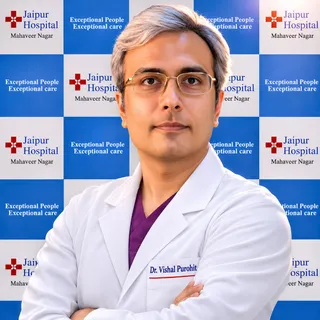
Your plastic surgery doctors
Explore our plastic surgery hospital in Jaipur: every treatment, the doctors and what to expect at your visit.
Frequently asked questions
Questions patients ask about scar revision surgery
What does scar revision surgery involve?
In short
Scar revision surgery at Jaipur Hospital involves removing or altering scar tissue to improve appearance or restore movement. The operation usually takes one to three hours under local or general anaesthesia. You may go home the same day or stay one night. Stitches are removed in seven to ten days and the final result appears over six to twelve months.
In detail
The surgeon evaluates the scar's size, location, direction and effect on function. Techniques include excision with careful closure, Z-plasty or W-plasty to reorient the scar along relaxed skin tension lines, geometric broken line closure to camouflage straight scars, and serial excision for wide scars.
For larger defects, skin grafts or local, regional or distant flaps may be used. Evidence shows surgical techniques can improve mature scars when selected for individual factors.
The goal is a thinner, flatter scar that matches surrounding skin colour and lies along natural folds without distorting nearby structures.
A common belief
Many people think the scar disappears completely.
What actually happens
Evidence shows scars cannot be fully removed. The aim is a thinner, less noticeable scar that follows natural skin lines and does not limit movement.
Your next step at Jaipur Hospital
After surgery you will need to keep the wound clean and protected. Avoid stretching the area for several weeks. Sun protection is essential for at least six months to prevent darkening. Silicone sheets or gels may be advised once the wound is healed. Most people resume light activity within a few days. Full maturation takes six to twelve months.
Which tests and scans do I need before scar revision surgery?
In short
Before scar revision surgery at Jaipur Hospital, routine preoperative tests are usually required. These include a complete blood count, blood sugar, liver and kidney function tests, coagulation profile, and screening for HIV, hepatitis B and hepatitis C. A chest X-ray and ECG may be needed if you are over forty or have medical conditions. The surgeon decides based on your age, health and the planned anaesthesia.
In detail
The tests check your fitness for anaesthesia and surgery. Blood counts detect anaemia or infection. Coagulation studies identify bleeding risk. Blood sugar is important because diabetes affects wound healing. Liver and kidney function guide drug dosing. Viral markers are standard for any invasive procedure.
If general anaesthesia is planned, the anaesthetist may request a chest X-ray and ECG to assess heart and lung function. No special imaging of the scar itself is routinely needed; clinical examination and photographs are sufficient for planning.
The surgeon may mark the scar and take measurements. If a flap or tissue expansion is considered, vascular assessment such as Doppler ultrasound may be used to check perforator vessels.
A common belief
Patients often expect MRI or CT scans of the scar.
What actually happens
In most cases clinical examination and photographs are enough. Imaging is only used when planning complex flaps or tissue expansion to check blood vessels.
Your next step at Jaipur Hospital
Arrange the tests a few days before your scheduled surgery so results are available for the anaesthetist. Bring all reports to the preoperative visit. If you take regular medicines, discuss them with the surgeon.
How painful is scar revision surgery and the early recovery?
In short
At Jaipur Hospital, scar revision surgery is performed under local or general anaesthesia so you feel no pain during the operation. After surgery, mild soreness or tightness is common and usually improves quickly. Most patients need only simple pain relief for a few days.
In detail
Evidence shows most scar revision procedures use local anaesthesia, while larger or complex scars may need sedation or general anaesthesia. During the procedure the area is numbed, so discomfort is minimal. Afterward, mild soreness or tightness may occur but typically resolves within the first week.
Initial healing takes one to two weeks, and suture removal happens at seven to ten days. Pain levels vary with scar size, location, and technique, but severe pain is uncommon.
A common belief
Some people expect severe pain or a long painful recovery.
What actually happens
In reality, most patients need only simple pain relief for a short time. The key is following wound care advice and avoiding tension on the new scar.
Your next step at Jaipur Hospital
Take prescribed pain medicine as directed. Keep the wound clean and avoid stretching the area. Most people return to light activity within a few days.
How long does recovery usually take after scar revision surgery?
In short
Recovery after scar revision surgery at Jaipur Hospital usually takes one to two weeks for initial healing, with stitches removed in seven to ten days. The final scar appearance continues to improve over six to twelve months as the scar matures. Most people return to light daily activities within a few days.
In detail
Evidence shows initial healing takes one to two weeks. Stitches are usually removed after three to four days for the facial area and after five to seven days for other body parts, though the hospital protocol notes seven to ten days.
Most people can resume normal activities soon after surgery, but you should avoid activities that stretch and may widen the new scar. If the scar is over a joint or a mobile area, you may need to limit movement for longer.
Swelling and bruising settle in the first two weeks. The scar goes through a maturation phase where it may look red or raised before fading. Silicone gel or sheets and sun protection are advised during this period. Full maturation takes six to twelve months.
A common belief
Many people think recovery ends when stitches are removed.
What actually happens
The scar is still active and changing for months. Protecting it from sun and tension during this time decides the final result.
Your next step at Jaipur Hospital
Plan for one week of reduced activity. Keep the wound clean and dry until stitches are removed. Avoid heavy lifting, stretching, or sports for two to three weeks or as advised. Use sunscreen on the healed scar for at least a year.
How is a keloid different from a raised or immature scar?
In short
A keloid grows beyond the original wound borders and does not regress over time, whereas a hypertrophic or immature scar stays within the wound edges and usually flattens as it matures. At Jaipur Hospital, the surgeon distinguishes these types by clinical examination and history before recommending treatment.
In detail
Evidence defines pathological scarring as including both keloid and hypertrophic scars. Keloids result from abnormal fibroblast proliferation, excessive extracellular matrix deposition, and chronic inflammation driven by immune dysregulation, mechanical stress, and hypoxia.
They extend past the original injury, often recur after excision, and can cause pain and itching. Hypertrophic scars are raised and red but remain confined to the wound margins; they typically improve over 12 to 18 months as collagen remodels.
Immature scars are early in the healing cascade, often red, firm, and slightly raised, but they follow a normal trajectory toward a flat, pale line. Mechanical tension on a healing wound increases the risk of both hypertrophic and keloid formation, especially over joints. The surgeon assesses scar behaviour, duration, family history, and location to classify the lesion accurately.
A common belief
People often confuse any raised scar with a keloid.
What actually happens
The key difference is that keloids invade surrounding healthy skin and have a high recurrence rate after simple excision, while hypertrophic scars respond better to time and conservative care.
Your next step at Jaipur Hospital
If your scar is growing beyond its original edges, is very itchy or painful, or has not improved after a year, it may be a keloid.
The surgeon will examine it and discuss options such as pressure therapy, steroid injections, or surgical excision with adjuvant treatment. Early assessment helps choose the right approach.
How will appearance, function, and realistic expectations be discussed for scar revision?
In short
At Jaipur Hospital, the surgeon evaluates your scar in detail, explains what revision can and cannot achieve, and discusses how the scar affects movement or sensation. The conversation covers likely improvement in colour, texture, and contour, as well as any functional gain such as release of a contracture.
In detail
Evidence states that scars cannot be completely removed; the goal is to make the scar less conspicuous and to restore function where it is limited. The surgeon assesses scar size, location, direction relative to relaxed skin tension lines, thickness, and maturity.
Photographs may be taken for records. The surgeon explains that final results take 6 to 12 months to appear, that a new scar will form, and that recurrence or worsening is possible, especially with keloids.
Functional assessment includes checking joint range of motion, nerve sensation, and any tethering to deeper structures.
If the scar distorts features like the eyelid or lip, the surgeon explains the risk of further distortion and how techniques like Z-plasty or local flaps aim to prevent it. You are encouraged to ask questions and share your priorities — whether appearance, comfort, or movement matters most.
A common belief
Some patients expect the scar to disappear.
What actually happens
The honest conversation is about making the scar thinner, flatter, and better aligned — not invisible. Understanding this upfront prevents disappointment later.
Your next step at Jaipur Hospital
The consultation lasts 20 to 30 minutes. You will receive a clear summary of the proposed plan, the steps involved, recovery timeline, and follow-up schedule. No promise of a specific outcome is made. You can take time to decide.
Why might my doctor recommend scar revision surgery?
In short
A doctor may recommend scar revision surgery at Jaipur Hospital when a scar limits movement, causes pain or itching, or creates a noticeable deformity. Surgery is considered for hypertrophic scars, keloids, contractures that restrict joints, wide or depressed scars, and scars that distort features such as the eyelid or lip. The decision balances functional need with cosmetic improvement.
In detail
Scars that cross joints can tighten and limit motion, a condition called contracture. Pathological scars such as keloids and hypertrophic scars may be painful, itchy or continue to grow. Wide scars result from tension during healing. Depressed scars occur when deeper tissue is lost.
Evidence shows surgical techniques like Z-plasty, W-plasty, geometric broken line closure, serial excision, tissue expansion, skin grafts and flaps can release tension, reorient scars along relaxed skin tension lines and replace scarred tissue with healthier skin. The surgeon chooses the method based on scar type, location, skin laxity and your overall health.
A common belief
Some people assume scar revision is only cosmetic.
What actually happens
In many cases it is functional, releasing tight bands that prevent normal joint motion or relieving chronic discomfort from pathological scars.
Your next step at Jaipur Hospital
If your scar affects daily activities or causes discomfort, do not wait for it to worsen. Early assessment allows the surgeon to plan the simplest effective approach. You will need a clinical examination and possibly photographs for records.
How should I prepare in the days before scar revision surgery?
In short
In the days before scar revision surgery at Jaipur Hospital, follow your surgeon's specific instructions. Stop smoking at least two weeks before as it impairs wound healing. Avoid alcohol for forty-eight hours. Inform the surgeon of all medicines, supplements and herbal products you take. Arrange for an attendant to stay with you if an overnight stay is planned. Keep the skin around the scar clean and free of infection.
In detail
Smoking reduces blood flow and increases the risk of wound breakdown, infection and poor scarring. Evidence shows malnutrition and low albumin also increase complications, so eat a balanced diet with adequate protein, vitamins A, C, B complex, zinc and antioxidants.
If you take blood thinners, aspirin, NSAIDs, isotretinoin or immunosuppressants, the surgeon will advise when to stop or adjust them. Do not apply creams, oils or makeup on the scar area on the day of surgery.
Wear loose, comfortable clothing that does not rub the scar site. If you develop a fever, cold or skin infection near the scar before surgery, inform the hospital immediately as the procedure may need to be postponed.
A common belief
Some people continue supplements like vitamin E, fish oil or herbal products that can increase bleeding.
What actually happens
The surgeon must know everything you take so they can advise what to stop temporarily.
Your next step at Jaipur Hospital
Complete any prescribed tests and bring the reports. Confirm your admission time and fasting instructions. Prepare a small bag with essentials if staying overnight. Have silicone gel or sheets ready for postoperative use if advised.
What are the common side effects and the less common serious complications of scar revision surgery?
In short
Common side effects after scar revision surgery at Jaipur Hospital include mild swelling, bruising, and temporary numbness around the incision. These usually settle within one to two weeks. Less common serious complications include wound infection, bleeding, wound separation, and the scar returning or becoming more noticeable.
In detail
Evidence shows risks of scar revision surgery include scar recurrence, keloid formation or recurrence, and separation or reopening of the wound, known as dehiscence. Infection and bleeding are surgical risks that occur in a small number of cases.
Hypertrophic scars or keloids can come back, especially in people prone to them. Nerve injury causing lasting numbness is rare. Poor wound healing may happen if there is tension on the edges, infection, or if you have diabetes or smoke.
The surgical team uses careful technique, layered closure, and dressings to minimise these risks. You will be told how to recognise signs of infection such as increasing redness, warmth, pus, or fever.
A common belief
Many people worry only about the scar looking worse.
What actually happens
Infection and wound separation are real risks that need early treatment. Keloid recurrence is higher in some skin types. Following care instructions lowers these chances.
Your next step at Jaipur Hospital
Keep the dressing clean and dry. Watch for spreading redness, increasing pain, swelling, or discharge. Attend all follow-up visits for suture removal and scar checks. Silicone gel or sheets may be advised after healing to improve the final result.
Which symptoms are expected after scar revision surgery, and which need urgent medical attention?
In short
After scar revision surgery at Jaipur Hospital, expected symptoms include mild swelling, bruising, soreness, tightness, and temporary numbness around the incision for the first few days. Symptoms needing urgent attention are increasing redness spreading from the wound, worsening pain not relieved by medicines, pus or foul-smelling discharge, fever above 38 degrees Celsius, sudden bleeding that soaks the dressing, or the wound edges pulling apart.
In detail
Evidence shows most patients experience minimal discomfort during the procedure and mild soreness or tightness afterward that improves quickly. Normal healing includes some bruising and swelling that peaks at two to three days and then fades. Numbness can last weeks as small nerves regenerate.
Warning signs of infection are spreading redness, warmth, increasing pain, and discharge. Wound dehiscence appears as edges separating or a sudden gush of fluid. Bleeding that does not stop with gentle pressure for ten minutes needs review.
Keloid recurrence shows as thick, growing scar tissue beyond the original border months later. The surgical team gives written instructions on when to call or visit the emergency department.
A common belief
Patients often ignore early infection signs, thinking they are normal healing.
What actually happens
Spreading redness and fever are not normal. Early treatment prevents serious complications. Know the difference before you go home.
Your next step at Jaipur Hospital
Keep the emergency numbers handy. Do not wait if you notice spreading redness, fever, or the wound opening. Contact the hospital or visit the 24-hour emergency department. Attend all follow-up visits so the surgeon can catch early problems.
FAQ library
Questions and answers about scar revision surgery
When you contact us
Get a clear plan for your scar
Contact Jaipur Hospital for a plastic surgery OPD consultation, in-house tests if needed, a cost estimate and help with cashless schemes.
- A consultation with a plastic surgeon in the OPD
- Your scans and reports reviewed, with tests done in-house if you need them (laboratory, X-ray and imaging)
- Your options explained in plain words, including whether you need surgery at all
- A cost estimate before you decide
- Help with cashless treatment under RGHS, MAA Yojana, CGHS and empanelled insurers and TPAs
- Follow-up visits after your treatment
Overview
Scar Revision Surgery: what to know
What scar revision surgery is and how scars form
- Normal scar formation
- Collagen fibres repair deep wounds
- Ideal scar
- Thin, flat, good colour match
- Hypertrophic scar
- Thick and raised
- Keloid scar
- Excessively large and lumpy
- Sunken scar
- Flat, discoloured, or sunken
Scar revision surgery is a procedure designed to improve the appearance, size, or texture of a scar. It may be performed for cosmetic reasons or when a scar causes functional problems such as limiting movement. Scars cannot be completely removed. The aim is to create a new scar that is typically smaller, thinner, or less noticeable than the original.
Scar tissue forms as skin heals after an injury or surgery. When a wound reaches the deeper layer of the skin, the body produces collagen fibres to repair the damage. This new tissue has a different texture and quality than the surrounding skin.
An ideal scar is thin and flat, has a good colour match with the surrounding skin, and lies along the natural skin tension lines without distorting nearby structures.
The final look of a scar depends on the size, depth, and location of the original wound, as well as the person's age and how the wound healed. Scars can be thick and raised, known as hypertrophic scars, or excessively large and lumpy, known as keloid scars. They may also be flat, discoloured, or sunken beneath the surface.
Symptoms and warning signs that need urgent care the same day
- Infection signs Increasing redness, swelling, warmth, discharge
- Sudden bleeding Soaks through the dressing
- Wound gaping open Edges separate
- Fever High temperature after surgery
A mature scar may cause discomfort through pain, itching, or redness. These symptoms are common in pathological scars such as keloids and hypertrophic scars.
Some scars restrict movement when they cross a joint or lie on a mobile area. This tightening, called a contracture, can limit the function of muscles, joints, and tendons.
After scar revision surgery, you should seek care on the same day if you notice signs of infection such as:
- Increasing redness
- Swelling
- Warmth
- Discharge from the wound
Sudden bleeding that soaks through the dressing, a wound that gapes open, or a fever also need prompt medical attention.
Causes and who is at higher risk
- Normal healing
- Collagen deposition after injury
- Pathological scars
- Prolonged inflammation, excess collagen
- Mechanical tension
- High tension sites prone to bad scars
- Diabetes or immunosuppressants
- Impaired healing, higher complication risk
- Isotretinoin use
- Delay scar revision while on it
- Poor nutrition
- Low albumin increases wound breakdown risk
Scars form as part of the normal healing process. The amount of scarring depends on the size, depth, and location of the wound, and on the person's age.
Pathological scars such as keloids and hypertrophic scars arise when the inflammation phase of healing is prolonged or more intense, leading to abnormal fibroblast activity and excessive collagen deposition. Mechanical tension on the wound edges is a strong trigger; skin sites under high tension have a high propensity for these scars. Immune dysregulation and low oxygen levels in the tissue also contribute.
Scars that run vertically along the long axis of a body part are under greater tension than horizontal scars. Closing a wound under tension produces a thin, wide scar. Tight suturing strangulates tissue and impairs blood supply, causing a poor scar.
People with diabetes or those taking immunosuppressants may have impaired healing and a higher risk of complications. Patients on isotretinoin for severe acne are usually advised to delay scar revision. Poor nutrition, indicated by low albumin levels, increases the risk of wound breakdown and infection.
How scar revision is diagnosed: examination and tests
Your surgeon will evaluate the type, location, cause, severity, and size of your scar before building a treatment plan. The assessment includes checking whether the scar limits movement or causes pain.
Scars are often assessed using standardised scales that rate features such as colour, texture, thickness, and pliability. In clinical studies, independent observers use tools like the Patient and Observer Scar Assessment Scale to measure improvement.
No routine laboratory tests are required for scar revision. If you have an underlying condition such as diabetes, your surgeon may ask for recent blood sugar reports to ensure it is controlled before surgery.
Treatment options without surgery and when surgery is advised
Non-surgical options include topical treatments such as silicone gels or sheets, which are worn for many hours a day over several months. Steroid injections can soften or shrink raised scars, but multiple sessions are usually needed. Skin resurfacing methods like dermabrasion, microneedling, or laser therapy remove the upper layers of skin to improve texture and stimulate collagen. These carry risks of redness, swelling, blistering, and colour changes.
Surgery is advised when a scar causes functional problems such as a contracture that limits joint movement, when non-surgical treatments have not achieved the desired improvement, or when the scar is wide, depressed, or distorted.
Surgical techniques include:
- Simple excision and careful closure
- Z-plasty or W-plasty to reorient the scar and reduce tension
- Skin grafting for larger defects
- Flap surgery when bulk and blood supply are needed
Tissue expansion stretches nearby healthy skin over weeks before the scar is excised.
Your surgeon will advise which technique suits your scar based on its location, size, direction, and the laxity of surrounding skin. For example, Z-plasty is indicated for scars contracted or running more than 30 degrees off the natural skin lines, while W-plasty is suitable for scars on flat facial surfaces but not over major joints.
Preparing for scar revision surgery
Do
- Attend OPD consultation
- Bring medicine list or strips
- Bring an attendant
- Wear loose, comfortable clothing
Avoid
- Stop isotretinoin if advised
Your surgeon will see you in the OPD before the operation. They will ask about the scar, how it happened, and whether it limits movement or causes pain, itching or redness. They will check the scar's size, depth, location and direction, and feel the surrounding skin for laxity.
They will also ask about your general health, any medicines you take, and whether you have diabetes or take immunosuppressants, as these can affect healing. If you are on isotretinoin or similar medicines for severe acne, your doctor may ask you to stop them for a period before surgery.
You may need routine blood tests and a chest X-ray or ECG depending on your age and health. The anaesthesia team will review you if general anaesthesia is planned. Most scar revision procedures use local anaesthesia; for larger or more complex scars, sedation or general anaesthesia may be used.
You will be asked to fast for at least six hours before the operation if you are having sedation or general anaesthesia. For local anaesthesia alone, a light meal is usually allowed. Wear loose, comfortable clothing that does not rub on the scar area. Bring an attendant who can stay with you and take you home afterwards.
If you use any regular medicines, bring the list or the strips with you. The hospital has an in-house pharmacy and diagnostic laboratory, so any last-minute tests can be done on the same day.
How scar revision surgery is done
On the day of surgery, you will be admitted to the daycare ward or a room for an overnight stay. The operation typically takes one to three hours. The surgeon marks the scar and the planned incisions while you are awake, often with you sitting or standing so the skin tension lines are clear.
The technique your surgeon chooses depends on the scar type, location, and the laxity of the surrounding skin. Common surgical options include:
- Z-plasty: Reorients the scar along skin tension lines by transposing triangular flaps. It is used for scars that cross tension lines, are contracted, form a web, or lie on curved surfaces or concavities. The central limb of the Z is placed along the scar, and the flaps are transposed so the new central limb lies more favourably. Multiple Z-plasties along a long scar can give a better result than a single large one.
- W-plasty: Breaks a straight scar into an irregular zig-zag pattern so that most small limbs lie along relaxed skin tension lines. It is indicated for scars on flat surfaces such as the cheek or the area between the lower lip and the jaw, but not for major joints such as the axilla or elbow. The scar is excised with small triangular advancement flaps that interdigitate on closure.
- Geometric broken line closure: Converts a long linear scar into a randomly irregular pattern using interlocking geometric shapes (triangles, rectangles, squares, semicircles) so the scar reflects light poorly and is less conspicuous. The ends are closed with shallow angles to avoid dog-ears.
- Serial excision: Removes a wide scar in stages. At each stage the scar margins are excised and the surrounding tissue is undermined and advanced. The amount excised each time depends on tissue pliability, and stages are planned so the final scar lies along a tension line.
- Tissue expansion: A silicone expander is placed under healthy skin near the scar and gradually inflated over weeks. The expanded skin is then used to replace the scarred area after excision. This provides skin that matches the colour and texture of the area.
- Skin grafting or flap cover: For very wide or contracture scars, the entire scar may be excised and covered with a split-thickness skin graft, a full-thickness skin graft, or a local, regional or distant flap. Full-thickness grafts are preferred for secondary reconstruction because they retain skin adnexal structures and give a better aesthetic result. Flaps bring their own blood supply and are useful where tissue vascularity is poor.
During the operation, the surgeon handles tissue gently, uses minimal cautery near the edges, achieves careful haemostasis, and places deep buried sutures to take tension off the skin edges. Skin edges are everted slightly with fine sutures so they lie together without tension.
If the scar is near a vital structure such as the eyelid, nose ala or eyebrow, the surgeon takes care not to distort it. Any dog-ear that forms is corrected at the same time.
Anaesthesia is given as planned: local infiltration for smaller scars, or sedation or general anaesthesia for larger ones. After the procedure, a light dressing is applied. For keloid revision, a pressure or elastic dressing may be used to reduce the chance of recurrence.
Risks and possible complications of scar revision surgery
- General surgical risks
- Anaesthesia reactions, bleeding, clots, infection
- Infection and bleeding
- At the surgical site
- Wound separation
- Dehiscence under tension
- Scar recurrence
- New scar may form
- Keloid recurrence
- In people prone to keloids
- Graft or flap failure
- May need further surgery
Scar revision creates a new scar that is typically smaller, thinner or less noticeable than the original. However, all surgery carries risks. General surgical risks include reactions to anaesthesia, breathing problems, bleeding, blood clots and infection. Specific risks of scar revision include:
- Infection and bleeding at the surgical site.
- Wound separation or reopening (dehiscence), especially if the edges are under tension.
- The scar may return, or a new scar may form.
- Keloid formation or recurrence, particularly in people prone to keloids.
- Hypertrophic scarring, which can restrict movement if it occurs over a joint.
- Poor skin quality, hyperpigmentation or contraction of a skin graft.
- Flap edge necrosis if scarred tissue is included in the flap or if tension is too high.
- Graft failure or contracture, which may need further surgery.
- Temporary discomfort during the interim period if a distant flap is used.
- Unsightly bump during tissue expansion.
Studies show that careful technique — gentle handling, eversion of edges, deep sutures to relieve tension, and alignment along relaxed skin tension lines — reduces these complications. Negative pressure wound therapy (NPWT) may be used to secure grafts, reduce tension and lower infection rates in selected cases. Your surgeon will discuss which risks apply most to your scar and the planned technique.
Recovery and aftercare after scar revision surgery
Most patients experience minimal discomfort during the procedure because the area is numbed. Afterward, mild soreness or tightness may occur but usually improves quickly. Initial healing takes one to two weeks.
Stitches are usually removed after three to four days for the facial area, and after five to seven days for incisions on other parts of the body. A light dressing is kept on the wound; for keloid revision, a pressure or elastic dressing may be continued for longer.
You can usually resume normal activities soon after surgery, but your doctor will tell you to avoid activities that stretch and may widen the new scar. If the scar is over a joint and you have long-term stiffening, you may need physiotherapy after surgery. The hospital has a physiotherapy department on site.
Protecting the scar from sun exposure during healing is important. Apply sunscreen to keep sunlight from darkening the healing scar. Exposing the scar to too much sun may cause it to darken, which could interfere with future revision.
Scars take time to mature. Most scars need 12 to 18 months to mature fully, and the final result is usually seen at six to 12 months. During this period the scar will shrink and become less noticeable as it ages.
Your surgeon will review you in the OPD at intervals to check healing and advise on scar massage, silicone strips or other topical care if needed.
Contact the hospital or your surgeon if you notice increasing pain, redness, swelling, discharge from the wound, fever, or if the wound edges separate. The 24×7 emergency department is available for any urgent concerns.
Results of scar revision surgery
- Z-plasty
- Reorients scar, releases contractures
- W-plasty
- Breaks scar into small segments
- Geometric broken line closure
- Random irregular pattern, less conspicuous
- Tissue expansion
- Provides matching colour and texture
- Full-thickness grafts
- Retain adnexal structures, better aesthetic
The goal of scar revision is to help the scar more closely match the colour and texture of the surrounding skin. Surgery can reduce the appearance of scars and minimise discomfort associated with them. It may be performed for cosmetic reasons or when a scar causes functional problems such as limiting movement.
Studies show that when surgical techniques are selected on the basis of individual factors and used with appropriate timing, they can improve mature scars. Specific techniques have demonstrated benefits:
- Z-plasty reorients the scar along tension lines, releases contractures, and segmented scars mature faster than long linear scars.
- W-plasty breaks a straight scar into multiple small segments, many of which lie along relaxed skin tension lines, making the scar less conspicuous because it reflects light more poorly.
- Geometric broken line closure creates a randomly irregular pattern that is less conspicuous than W-plasty or multiple Z-plasty.
- Local flaps expand naturally after surgery and are not prone to post-surgical contractures.
- Tissue expansion provides skin that matches the recipient site in colour and texture.
- Full-thickness skin grafts retain adnexal structures and give a better aesthetic result than split-thickness grafts.
- Negative pressure wound therapy can improve graft survival and reduce reoperation rates.
However, scars cannot be completely removed. Scar revision is not likely to completely remove the scar. Results vary depending on the scar's size, location, and cause. In studies, patients reported significant improvement in scar appearance at six months. Recurrence of hypertrophic scars or keloids is possible, especially in people with a tendency to form them. Your surgeon will give you a realistic expectation based on your specific scar.
Cost and insurance for scar revision surgery in Jaipur
- ₹30,000 to ₹1,50,000 Typical price range in India
- NABH-accredited Hospital accreditation
- RGHS, MAA Yojana, CGHS Government schemes empanelled
The typical price range for scar revision surgery in India is ₹30,000 to ₹1,50,000. The final cost depends on the size and complexity of the scar, the technique used (for example, simple excision versus Z-plasty, tissue expansion, or flap surgery), the type of anaesthesia (local, sedation or general), and whether you stay as a daycare patient or overnight. Ask us for an estimate based on your specific case.
Jaipur Hospital is a NABH-accredited multispeciality hospital established in February 1991. We are empanelled under RGHS, MAA Yojana, CGHS, and a panel of private insurers and TPAs. If you are covered under any of these schemes, bring your card and any required documents.
The hospital has a 24×7 emergency department, in-house pharmacy, diagnostic laboratory and imaging, modular operation theatres, and an intensive care unit. For appointments or estimates, you can call 0141-2551500, 0141-2554139, or 7414 001 001, or email [email protected].